
Dispensary SEO: A Conversion-First Guide for 21+ Brands
- Doc. N°
- ELMTM-006
- Filed
- Rev.
- November 6, 2026
- Class
- 21+ Brands
- By
- Ethan Leard-Means
- Read
- 6 min

A dispensary's search presence has one job: get a nearby buyer who is ready to purchase through the door, or into an order, before they choose somewhere else. Most of that decision happens on a map listing and a menu page, often within a minute. Dispensary SEO is the discipline of winning that minute, and because paid search and paid social are largely closed to the category, it carries more of the acquisition load than it does for almost any other retailer.
The approach here is conversion-first. Rankings matter only to the extent that they produce visits and orders, so every step is judged by what it does for the buyer at the moment of choice.
Why dispensary SEO is different from standard retail SEO
Three constraints shape the work.
No paid fallback. A general retailer can cover weak organic visibility with search ads. A dispensary usually cannot. Local and organic search have to work on their own.
Compliance runs through the content. Product pages, descriptions and posts should describe products, formats and the shopping experience without therapeutic claims. Age gates have to be built so they overlay page content rather than hide it from search engines.
The listing ecosystem is wider. Beyond Google, Apple Maps and Bing, dispensaries appear on category directories and marketplaces that send shoppers who are already in buying mode. Each one has its own categories, menu formats and review system, and each one is another place where wrong hours or an outdated menu costs a sale.
The core pillars of a dispensary SEO program
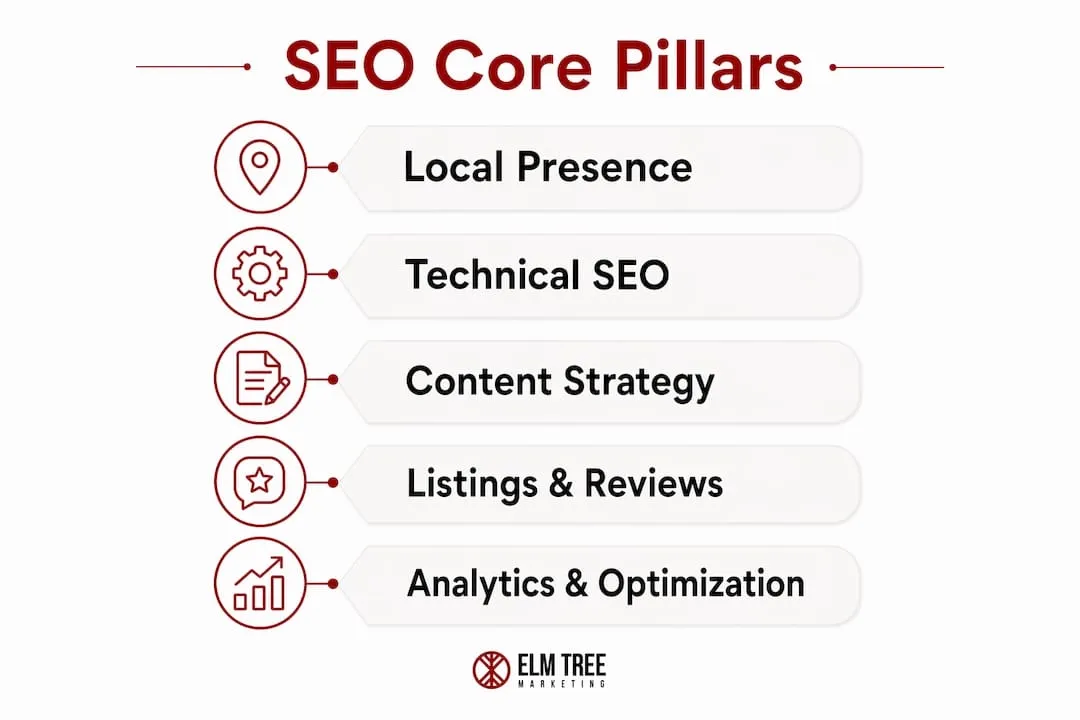
Five workstreams run together, and a gap in one weakens the others.
Local presence. A verified, complete Google Business Profile and consistent listings everywhere else.
Technical SEO. Fast mobile pages, secure and crawlable architecture, correctly built age gates, and structured data.
Content. Category, location and buying-guide pages on your own domain that answer the questions shoppers ask.
Listings and reviews. A consistent, policy-compliant way to request reviews, and a response to every one.
Analytics and optimization. Tracking that connects search activity to calls, direction requests and orders, reviewed on a regular cadence.
Google Business Profile comes first
For most dispensaries, the Business Profile is the single most important search asset. Google says local results are based mainly on relevance, distance and prominence, and that businesses with complete and accurate information are more likely to show up. Distance you cannot change. Relevance and prominence you can.
Start with eligibility and accuracy. Google's Business Profile guidelines require the business name to match the real-world name used on the storefront and website, with no added keywords or taglines, and state that businesses selling age-restricted products such as cannabis are not permitted as service-area businesses without a storefront. A keyword-stuffed name or an ineligible listing type can lead to suspension, which costs far more than whatever it gained.
Then build relevance: choose the primary category precisely, complete every field that applies, keep hours current including holidays, and add real photos of the storefront, interior and staff. Post updates regularly. Treat the profile as a live storefront, not a directory entry.
Prominence is built over time, largely through reviews and the broader web's references to the business. Ask every customer in a consistent way, respond to every review with something specific, and never buy, filter or fabricate reviews.
Listings and directories to claim
After Google, claim and complete the listings that shoppers and search engines rely on.
| Listing | What to complete | Why it matters |
|---|---|---|
| Apple Maps | Name, address, phone, hours, photos, category | Default maps app on iPhone |
| Bing Places | Name, address, phone, hours, photos | Bing results and some assistant answers |
| Cannabis directories and marketplaces | Menu, hours, photos, licensing details where required | Shoppers already comparing stores |
| Yelp and general directories | Name, address, phone, hours, category | Corroborating references across the web |
Consistency matters more than volume. Name, address and phone should match exactly everywhere. When something changes, update every listing in the same week. The broader logic of which citations still matter is in our guide to local SEO citations.
Website and technical checklist
The listing gets the click. The website has to finish the job.
Build crawlable pages around the embedded menu. Menus from point-of-sale platforms often load inside an iframe or through scripts, which can leave the product content attributed to the vendor's domain or not indexed as part of your site. Create category pages, format guides and location pages on your own domain that search engines can read, and link the menu from them.
Fix the age gate. It should overlay content that is already in the page, not replace it, so search engines can still read what sits behind it.
Add structured data. Google documents local business structured data for name, address, hours and other details. Make sure it matches the Business Profile exactly.
Make every location page genuinely local. Hours, directions, parking, nearby landmarks, what the store is known for. Swapping the city name in a template is not a location page.
Make the next step obvious. Call, get directions, start an order. On mobile, these should be visible without scrolling.
Protect visibility during migrations. When changing site platforms or menu providers, map every existing URL to its new equivalent with redirects before launch.
A practical roadmap
Dispensary SEO is sequenced, not simultaneous.
First: fix what is broken and claim what is yours. Verify and complete the Business Profile, correct name, address and phone inconsistencies across listings, fix the age gate and the most important crawlability issues, and set up a review request after each purchase.
Next: build the content layer. Category and location pages, a small set of buying guides built around the questions staff hear most often, structured data, and internal links that tie them together.
Then: build prominence and retention. Local press, community partnerships and relevant local links. Email and SMS capture on the site, so search visitors who buy once can be brought back. The retention side is covered in how dispensaries retain buyers without retargeting.
Timelines depend on the starting point, the market and the competition. Profile and listing fixes tend to show effects soonest. Content and authority take longer and compound once built.
What to measure
Measure what connects to revenue. From the Business Profile: calls, direction requests and website clicks. From the site: organic sessions to category and location pages, menu clicks and orders started. From the business: new customers and repeat purchases. Keyword positions are a useful diagnostic, not the goal.
Review these on a fixed cadence and look for where buyers drop out. If profile views rise but direction requests do not, the problem is the listing. If menu clicks rise but orders do not, the problem is the menu experience, which is conversion optimization work rather than SEO.
Where this fits
ELM Tree Marketing builds dispensary SEO as one stage of a connected system: local visibility, a site that converts, and follow-up that brings buyers back.
If you want a documented read on which of those stages is costing you the most visits and orders, a Growth Analysis examines each one and sets the order of the fixes.