
How Dispensaries Retain 21+ Buyers Without Retargeting Ads
- Doc. N°
- ELMTM-068
- Filed
- Class
- 21+ Brands
- By
- ELM Tree Marketing
- Read
- 11 min
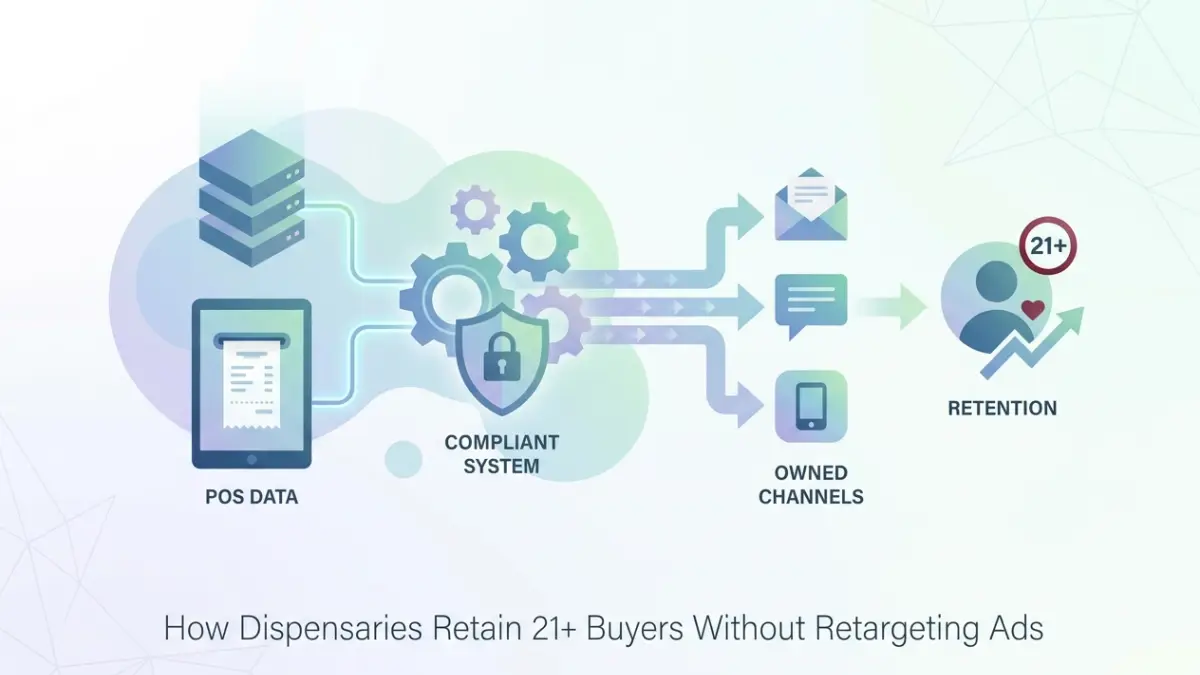
Your best customers already walked through the door. The problem is that most dispensaries let them leave without capturing a single way to bring them back. In restricted 21+ retail, retargeting ads are not a dependable retention plan. The smarter play is cannabis dispensary marketing built at the point of sale: turn anonymous walk-ins into an addressable list, send purchase-triggered messages, and design repeat visits around real purchase cycles instead of one-off promotions.
This tutorial maps that system step by step. You will learn why retargeting is not a retention plan for 21+ retail, why retention is built at the point of sale, and how to turn walk-ins into a compliant addressable audience. You will also see what to capture at checkout, offers that earn the opt-in without breaking promotion rules, purchase-triggered flows to build first, and how to time repeat visits around purchase cycles. We will close with compliance guardrails, dispensary SEO as an owned always-on channel, and next steps for turning retention into a repeatable system.
Why Retargeting Is Not a Retention Plan for 21+ Retail
Even where state law permits licensed marketing, major ad platforms restrict cannabis and 21+ categories at the account level. Pixel-based remarketing audiences are heavily restricted or unavailable for most dispensaries and smoke shops on major platforms; verify current platform policies before assuming any targeting option is open.
This is a platform-plus-state-rule reality, not one statute. Platform cannabis policies and state rules combine to limit targeting, pixel installation, and creative. New York's Part 129 governs marketing and advertising for cannabis licensees, covering ad content, prohibitions, signs and billboards, discounts, and retail premises.
Retargeting also fails on timing. A 21+ customer's repurchase interval is likely measured in weeks rather than browsing sessions, so a cookie-based pixel would reach them at the wrong moment in their cycle.
Rented reach stops the day the budget does; a permissioned contact list keeps producing visits with no media spend. That distinction is why cannabis marketing without paid ads requires a different operating system.

Retention Is Built at the Point of Sale
Your point of sale is not a checkout; it is a data system. Every transaction already generates basket size, category mix, time of day, and visit frequency. The only missing input is a consented way to reach that customer again.
Keep acquisition and retention on separate lines. Acquisition here is paid, restricted, and rented. Retention is owned, permissioned, and repeatable. They should never share a budget or a KPI.
The 21+ age gate works in your favor: verification already happens at the door and at the counter, which makes that same moment a natural, defensible place to capture an opt-in rather than a separate funnel. The mechanics resemble how ELM Tree Marketing (ELMTM) builds retention systems for gyms: capture where the customer already stands.
Run the leakage math. A shop doing 100 transactions a day at a 20 percent capture rate adds roughly 600 contacts per month, about 7,200 per year before repeat customers are deduplicated, at zero media cost. Treat those figures as starting estimates to test against your own POS data, not industry benchmarks. Start with 20 percent as a working hypothesis and adjust once you have a full month of shift data.
Before any tactic, baseline five numbers: repeat rate, 60-day return rate, 90-day return rate, average days between visits, and average basket for returning versus new customers. Without them, no tactic can be judged. Repeat customers shop more categories and return more often, which is why retention compounds where promotion chasing does not.
Step 1: Turn Walk-Ins Into an Addressable List
Now build the asset. Treat this as infrastructure, not a one-off campaign: a permissioned, age-gated, segmented list that lives in your business, not a platform ad account.
Capture happens across three surfaces already in your operation. The counter and POS prompt lets staff ask during checkout. A QR code on the receipt or packaging insert captures customers who skip the pitch. A single-field signup screen at pickup handles pre-order and pickup traffic.
Do not buy third-party lists. In restricted categories those contacts are typically unverifiable for age and consent, creating compliance exposure and poor deliverability.
What to Capture at Checkout
Capture the minimum viable dataset, and nothing more: mobile number or email, first name, confirmed 21+ status, purchase category tags, store location, and a consent timestamp. Skip full date of birth. It adds liability without adding reach.
Keep the exchange under 15 seconds; budtenders will only run a script short enough to say between customers. Give them one line, plus per-shift attribution so they see the list they personally grew. Manage capture rate per transaction weekly, by shift.
Standardize the consent record: what the customer agreed to receive, the channel, the date, and the collection method. That documentation is the difference between a defensible program and an exposure, since marketing messages require prior express written consent.
Tag the first purchase category at capture. The list becomes segment-ready for purchase-triggered messaging on day one instead of needing a cleanup later.
Offers That Earn the Opt-In Without Breaking Promotion Rules
The offer determines whether list building compounds or creates exposure. Lead with non-price incentives, since discount and promotional pricing rules are the most explicitly defined part of many state frameworks. Early access to drops, member-only hours, product education, and pickup priority drive opt-ins without touching price mechanics.
If a discount fits your state, read the actual text. New York's Part 129 (New York licensees; verify equivalent provisions for your state) includes a dedicated discounts and promotional pricing section, and permitted discounts are conditional there, including no sales below market value and tax calculated on the pre-discount price.
Don't stack offers into the recruitment ask. Keep it simple and compliant on its own before loyalty points or referral credit are layered on. Train staff to frame it as a value exchange: what the customer gets and how often they'll hear from you, with identical language on the signup screen and welcome message.
Measure capture rate, unsubscribe rate, and first-message engagement together. High opt-ins followed by immediate unsubscribes means the offer overpromised or the cadence was wrong.
Step 2: Replace Retargeting With Purchase-Triggered Messaging
Retargeting follows browsing behavior across the web. Purchase-triggered messaging follows what a customer actually bought and when they will need it again. The second signal is stronger, and it is the one a restricted shop is allowed to own.
Build flows from POS events, not calendar dates: first purchase, second purchase, category repeat, high-value basket, and lapse. Each event triggers one message with one job, whether that is welcome, replenish, expand, recognize, or win back.
Set timing from the customer's own behavior. As a starting point, welcome within 24 hours, anchor replenishment reminders to that individual's average interval, and send lapse nudges at roughly 1.5 times their normal interval. Adjust each window against your own POS data. Fixed weekly blasts ignore data the POS already provides.
Split channels by job. SMS for time-sensitive replenishment and drop alerts. Email for education, category expansion, and longer-form content. Both stay consent-gated, and both honor opt-outs within the legally required window (10 business days under CAN-SPAM/TCPA).
Resist cadence inflation. Sending more often is the fastest way to burn a list built over a year of counter conversations. Personalization about what the customer bought outperforms broad promotional pressure.
Report on revenue per message and repeat visit rate per flow, not open rates alone.
Example Flows to Build First
Once purchase triggers are live, sequence these five flows first.
First visit follow-up: As a starting point, send a thank-you within 24 hours, a short usage note, and one reason to return within 10 days. This converts a walk-in into a recognized customer.
Replenishment: Time reminders to each customer's own cycle, never a fixed weekly send. A 21-day buyer and a 9-day buyer need different cadences.
Lapsed customer: As a starting point, re-engage near 60 days with a category recommendation from their last purchase, not a blanket discount. Keep it lock-screen short.
Category expansion: As a starting point, around 14 days after first purchase, introduce one adjacent category that fits the original basket. This grows average order value without discounting.
High-value basket: Recognize larger or multi-category buyers with early access or member perks, then route them to pickup or pre-order for a frictionless return.

Step 3: Design Repeat Visits Around Purchase Cycles
Calculating each customer's natural repurchase interval from POS data turns messaging into demand timing. Place the prompt just before that window closes instead of on a fixed calendar.
Cycle length varies by product category; pull your own POS data to segment cadences before assuming a single interval fits all buyers.
Then build return reasons that are not price cuts: drop days, member hours, scheduled pickup, education events, and loyalty points earned on category mix rather than total spend. These mechanics hold up better against state promotion rules than discount-first programs.
Pre-order and pickup sync both behaviors: they reduce friction, make the return measurable, and give your list a reason to act before the customer is in the car.
Finally, report repeat visit rate by acquisition cohort, not revenue. A strong month can hide a falling return rate.
Compliance Guardrails for List Building and Promotions

Before any flow launches, verify your state's licensee marketing rules against the current text, not a summary. Part 129 extends to discounts, promotional pricing, and all in-store communications; verify the current codified text for your operation (New York licensees; verify equivalent provisions for your state).
Consent is infrastructure. Record opt-in source, channel, timestamp, and method for every contact, honor opt-outs within the legally required window, and keep records retrievable for the life of the list.
Keep the list 21+ gated, and keep creative away from anything that could read as appealing to minors: imagery, slang, and channels with heavy underage reach.
Compliance is an active audit area. Academic reviews of dispensary social media posts have found recurring violations, including health claims and content that could appeal to youth. Assume your own channels will be read with the same scrutiny.
Promotions carry the most risk. Pull your state's discount and promotional pricing provisions, and get counsel review for novel or high-stakes mechanics. Re-audit on a schedule; cannabis marketing rule changes may have implications for adjacent categories including hemp, smoke, and adult beverage, so verify separately for each license type.
Dispensary SEO as the Owned Always-On Channel
Compliance sets the boundaries; owned search is where retention lives. Organic and map results are a critical always-on surface a restricted shop can control without an ad account, which is why dispensary SEO belongs in a retention conversation, not a separate plan.
Optimize your Google Business Profile for repeat customers, not just discovery. Returning buyers check hours, pickup and pre-order options, product categories, and recent photos before a second visit. Keep photos current, choose categories that accurately describe your core business, and respond to reviews.
Build location and category pages that answer repeat-purchase intent, such as where to buy a specific product type in a specific city. Generic brand pages compete statewide with every other shop.
Route one landing page to your Google Business Profile, receipt QR codes, and in-store signage so capture rate is measurable by source. Track branded search volume, direct and map sessions, and repeat visit rate together; rising branded search alongside a rising repeat rate can be a sign owned channels are compounding.
Treat this as a first framework, not a settled standard: local search as a retention channel is under-documented for this category.
Next Steps: Turning Retention Into a System
Local search compounds only when the list and flows behind it exist. If you haven't started, this week's action is the counter script and single-field signup from Step 1. That single change creates the asset everything else depends on.
Use the baseline metrics from Step 1 to give every flow a number to beat. Then verify your state's marketing rules, including discount and promotional pricing provisions, and confirm opt-in documentation requirements for email and SMS before any offer goes out.
Sequence the work: capture first, then first-visit and replenishment flows, then lapse and category expansion, then purchase-cycle visit design. Launching all at once stalls programs. Treat the list, flows, and local search as one compounding system. If you would rather not build it in-house, ELMTM designs structured retention and local search systems for 21+ and restricted-category brands, including dispensary SEO and Google Business Profile work, and can run the sequencing alongside your team.
Conclusion
Retargeting ads do not retain 21+ buyers. Retention is built at the point of sale: turn walk-ins into an addressable list, send purchase-triggered messages, and design repeat visits around real purchase cycles. Compliance guardrails and owned local search keep that system compounding. The system builds in sequence: list first, then flows, then local search, each layer compounding on the last. If you want to know where your own retention is leaking, apply for a Growth Analysis. Build the list, respect the rules, and let owned channels turn repeat visits into durable growth.
FAQ
Why isn't retargeting a reliable retention plan for 21+ retail?
Major ad platforms restrict cannabis and 21+ categories at the account level, so pixel-based remarketing audiences are heavily restricted or unavailable for most dispensaries and smoke shops. Even where state law permits licensed marketing, retargeting also misses timing: a 21+ customer's repurchase interval is measured in weeks, not browsing sessions. Verify current platform policies before assuming any targeting option is open.
How do dispensaries capture customer data at the point of sale?
Capture happens across three surfaces: a counter and POS prompt during checkout, a QR code on the receipt or packaging insert, and a single-field signup screen at pickup or pre-order. The minimum dataset includes a mobile number or email, first name, confirmed 21+ status, purchase category tags, store location, and a consent timestamp. Skip full date of birth, since it adds liability without adding reach.
Should dispensaries buy third-party lists to grow their audience?
No. In restricted categories, third-party contacts are typically unverifiable for age and consent, which creates compliance exposure and poor deliverability. A permissioned, age-gated list built from your own customers is the defensible asset to grow.
What kinds of offers can encourage opt-ins without breaking promotion rules?
Lead with non-price incentives such as early access to drops, member-only hours, product education, and pickup priority, since discount and promotional pricing rules are the most explicitly defined part of many state frameworks. If a discount fits your state, read the actual text of its provisions first. Keep the recruitment offer simple before layering on loyalty points or referral credit.
How should timing for repeat-visit messages be set?
Base timing on each customer's own purchase behavior rather than fixed calendar blasts. As a starting point, send a welcome within 24 hours, anchor replenishment reminders to the individual's average interval, and send lapse nudges at roughly 1.5 times their normal interval. Treat these windows as hypotheses to adjust against your own POS data.