
Email Marketing for Gyms: Retention-First Playbook
- Doc. N°
- ELMTM-005
- Filed
- Class
- Fitness
- By
- Ethan Leard-Means
- Read
- 12 min

Build your gym's email system around one principle: behavior-triggered sequences plus a 2–4 email/month broadcast baseline. Start with three actions today. First, audit member states in your gym management system (prospect, new member, active, waning, lapsed). Second, activate the five critical triggers: welcome, trial-to-member, no-show follow-up, failed payment, and 30-day inactivity. Third, build one tracking dashboard that shows retention rate and revenue per email. Everything else in this playbook builds on those three moves.
Audit member lifecycle states in your CRM or gym management software
Activate the five core triggers listed above before any broadcast campaigns
Set a single dashboard tracking open rate, click-through rate (CTR), reactivation rate, and revenue per email
Why email marketing for gyms beats social for retention
Email bypasses the algorithm. A booking confirmation, a failed-payment alert, or a reactivation offer lands in the inbox every time. Social posts reach a fraction of your followers on a good day. For deterministic messages where visibility is non-negotiable, email wins by design.
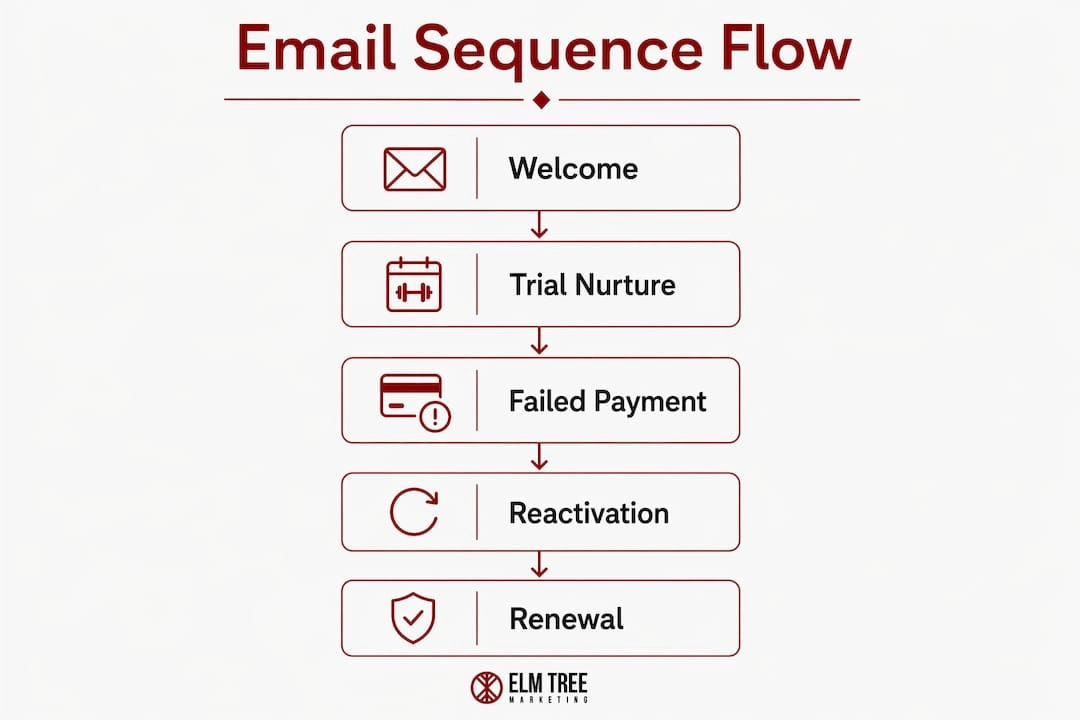
The cost argument is equally clear. Reactivating a lapsed member costs a fraction of acquiring a new one, and a well-timed re-engagement sequence does it at near-zero marginal cost. Generic promotional blasts, though, are a different story. Promotional open rates commonly fall below 15% for untargeted broadcasts, which is exactly why behavior-triggered sequences matter. A welcome email sent within minutes of signup can hit open rates of 60–90%+. That gap between 15% and 90% is where your revenue lives.
Pro Tip: Prioritize sequences tied directly to revenue events, specifically failed payments and trial expirations, before you spend time on a monthly newsletter. A single recovered payment covers weeks of email marketing effort.
What automated sequences every gym should run
Run these seven sequences before you send a single broadcast. Each one maps to a state transition, meaning the email only fires when a member's status actually changes.

Sequence | Trigger | First Send | Primary Action |
|---|---|---|---|
Welcome / onboarding | Form signup or membership purchase | Immediately | Book first class |
Trial nurture | Trial start | Immediate + 24h, 48h, 72h | Convert to paid member |
Class reminder / no-show | Class booking or missed class | 24h before / 2h after | Attend or rebook |
Payment dunning | Failed payment | Same day | Update payment method |
30-day inactivity | last_visit_at + 30 days | Day 30 | Return to gym |
Re-engagement drip | 60–90 days inactive | Day 30, Day 60, Day 90 | Reactivate or cancel |
Referral ask | Post-milestone (30d active, goal hit) | Day 31 or milestone date | Submit referral |
A four-email trial nurture sequence (immediate welcome, 24h follow-up, 48h objection handling, 72h final incentive) can lift trial-to-member conversions by 15–25%. That alone justifies the build time.
How often to email different member segments
The 2–4 emails/month baseline applies to broadcast campaigns sent to your full active list. Triggered sequences run on top of that, not instead of it.
Segment your cadence by lifecycle state:
Prospects (pre-member): Weekly while actively nurturing. Drop to bi-weekly if they go cold after two weeks.
Active members (0–90 days): 2–4 broadcasts/month, mostly operational and value content (class schedules, tips, community updates).
Dormant members (30–90 days inactive): Re-engagement drip with decreasing frequency. Start at weekly, taper to bi-weekly by week four.
Lapsed (90+ days, no visit): One final win-back attempt, then suppress from broadcast lists to protect deliverability.
Content mix matters as much as frequency. Aim for 60–70% utility content (workout tips, schedules, member spotlights, a "Workout of the Week" feature) and 30–40% promotional or upsell messages. Flipping that ratio is the fastest way to spike unsubscribes.
Pro Tip: Add a preference center to your welcome email. Letting members choose content type (nutrition, class updates, offers) cuts unsubscribes and gives you richer segmentation data at zero extra cost.
Which segments to build and which triggers to use
Segment by lifecycle state first, then layer in behavior and product tier as secondary dimensions.
Primary segments:
Prospect (opted in, not yet a member)
New member (0–30 days)
Active member (visited in last 30 days)
Waning (31–60 days since last visit)
Lapsed (61–90 days)
Canceled
Secondary segments: class-type preference (yoga vs. HIIT vs. strength), membership tier (basic vs. premium), and product buyers (supplements, apparel, personal training add-ons).
Key triggers to map to database fields:
form_submitted_at → welcome sequence
first_visit_at → onboarding sequence
trial_end_date → trial-to-member conversion push
last_visit_at + 30d → inactivity alert
last_failed_payment_at → dunning sequence
Milestone events (30-day streak, goal logged) → referral ask
Pro Tip: Use plain-text payloads for transactional triggers (payment failure, inactivity alerts). Plain-text avoids the Promotions tab and lands in Primary, which directly improves open rates on your most revenue-critical messages.
What to measure and realistic benchmarks for gyms
Track retention impact and revenue per email alongside the standard open and click metrics. Open rate alone tells you nothing about whether email is actually reducing churn.
KPI | Promotional Benchmark | Triggered / Personalized |
|---|---|---|
Open rate | Below 15% | 60–90%+ (welcome/onboarding) |
Click-through rate | 1–3% | 5–10% |
Click-to-book conversion | Low single digits | Around 10% for class reminders |
Reactivation rate | N/A | 8–15% for 30-day inactivity flows |
Revenue per email | Varies | Track per sequence, not per blast |
A three-step A/B test plan to move these numbers:
Subject line: Test curiosity vs. direct benefit ("We miss you" vs. "Your free class expires Friday"). Run for two weeks minimum.
Send time: Test Tuesday/Thursday 7–9 AM against Wednesday 12 PM for your active segment. Gym members check email before and after workouts.
CTA: Test one link vs. two options (book a class / update your profile). Single CTAs typically outperform split options for transactional emails.
Inbox placement, authentication, and CAN-SPAM basics
Good deliverability comes from list hygiene and proper authentication, not from clever design. A beautifully branded HTML email sent to a stale list will underperform a plain-text message sent to a clean, permissioned one.
Technical setup checklist:
Enable SPF and DKIM records for your sending domain
Add DMARC with at minimum a p=none monitoring policy
Monitor bounce rates (keep hard bounces below 2%) and spam complaint rates (below 0.1%)
Suppress unsubscribes immediately, within the same send cycle
Never buy email lists; purchased contacts trigger spam traps and risk account suspension
CAN-SPAM compliance checklist (U.S.):
Sender name and "From" address must be accurate and identifiable
Subject lines must not be deceptive
Physical mailing address required in every commercial email
Unsubscribe mechanism must be clear and honored within 10 business days
This article is general information, not legal advice. Confirm current CAN-SPAM requirements with a qualified professional or the FTC's official guidance for your specific situation.
Where gyms reliably capture opt-ins
The best list growth comes from owned touchpoints, not paid acquisition. In-person and productized capture consistently outperforms paid list building for quality and deliverability.
Trial signups: Capture email at the point of trial registration; this is your highest-intent moment.
Front desk / kiosk: Tablet-based signup at check-in for walk-ins and day-pass visitors.
Class booking confirmation: Add an email opt-in checkbox to the booking flow for non-members.
Referral programs: Incentivize existing members to refer friends; capture the referred contact's email at the referral landing page.
Events and challenges: 30-day challenges and in-gym events generate high-quality opt-ins with built-in engagement intent.
Lead magnets on landing pages: A downloadable workout plan or nutrition guide promoted via social drives targeted opt-ins from people who are already fitness-motivated.
Implement immediate welcome sequencing the moment someone opts in. That first email, sent within minutes, confirms intent and sets expectations before the new subscriber forgets they signed up.
Plain-text templates and a 6-week example sequence
Plain-text, state-triggered emails outperform heavy HTML blasts for local and regional gyms. They load faster, avoid the Promotions tab, and feel personal.
Core templates:
Immediate welcome: "Welcome to [Gym Name]. Your first class is on us. Book here: [link]." Subject: "You're in — here's your first step"
Trial follow-up (24h): "How was your first session? Here's what to try next." Subject: "Quick question about yesterday"
No-show follow-up (2h after missed class): "We missed you today. Want to rebook?" Subject: "Your spot is still open"
30-day re-engagement: "It's been a while. Here's a buddy pass to come back." Subject: "We kept your spot warm"
Payment failure: "Your payment didn't go through. Update your info to keep your membership." Subject: "Action needed: your account"
Referral ask: "Enjoying [Gym Name]? Bring a friend and you both get a free month." Subject: "You've earned this"
6-week sequence (new trial member):
Week 1, Day 1: Immediate welcome email. Segment: new trial. Action: book first class.
Week 1, Day 2: Trial follow-up (24h). Segment: trial, no class booked. Action: book class.
Week 1, Day 3: Objection-handling email ("Not sure which class fits you?"). Action: take a quiz or call front desk.
Week 2, Day 7: Class reminder or "Workout of the Week" value email. Action: attend class.
Week 3, Day 14: Trial expiration notice with final incentive. Segment: trial, not yet converted. Action: upgrade to membership.
Week 6, Day 42: Re-engagement check-in for anyone who converted but hasn't visited in 14 days. Action: return to gym.
When to hire an agency vs. run it yourself
Hire if you lack time, data integrations, or a clear funnel. DIY when you have a small, manageable list and basic platform integrations already in place.
Decision checklist:
Factor | DIY | Hire |
|---|---|---|
Integration complexity | Simple (one platform) | Multiple systems, API work needed |
Staff bandwidth | Dedicated marketing staff | Owner-operated or lean team |
Monthly send volume | Under 3,000 contacts | 3,000+ or multiple locations |
CRM / data maturity | Basic tags and lists | Lifecycle fields, behavioral data |
Speed to impact | Can wait 60–90 days | Need results within 30 days |
A typical agency engagement for gym email covers: discovery and state audit, sequence library build (6–10 automations), platform integration, reporting dashboard setup, and monthly optimization. Project-based scoping for a sequence build generally runs in the low-to-mid four figures; ongoing retainer work for full execution and optimization runs higher depending on list size and platform complexity. Ask any agency you evaluate for a clear deliverables list before signing.
For fitness-specific email execution, the agency should demonstrate experience with gym management software integrations and lifecycle-state mapping, not just general email platform knowledge.
Key Takeaways
A retention-first gym email system built on behavior-triggered sequences and a 2–4 email/month broadcast baseline is the lowest-cost, highest-ROI way to reduce churn and grow revenue.
Point | Details |
|---|---|
Audit member states first | Map lifecycle states (prospect, new, active, waning, lapsed) in your CRM before building any sequence. |
Activate five core triggers | Welcome, trial-to-member, no-show, failed payment, and 30-day inactivity cover the highest-revenue moments. |
Use plain-text for triggers | Plain-text payloads avoid the Promotions tab and improve open rates on revenue-critical messages. |
Track revenue per email | Open rate alone misses ROI; reactivation rate and revenue per email show true channel performance. |
ELM Tree Marketing for done-for-you | ELM Tree Marketing builds audit-to-execution email systems for fitness brands, including sequence design, integrations, and reporting. |
The case for treating email as a revenue system, not a campaign
Most gyms treat email like a bulletin board: post a promotion, hope someone clicks, repeat. That framing is why promotional open rates stall below 15% and why members quietly cancel without ever seeing a retention message.
The more useful frame is state management. Every email should move a member from one state to a better one: prospect to trial, trial to member, waning to active, lapsed to reactivated. When you design sequences around state transitions instead of calendar dates, the emails feel relevant because they are relevant. A no-show follow-up two hours after a missed class lands differently than a generic "we miss you" blast sent on the first of the month.
The counterintuitive part: sending less, but smarter, usually outperforms higher frequency. A gym that sends four well-timed triggered messages a month will outperform one sending daily blasts to its full list. Deliverability improves, unsubscribe rates drop, and the members who do open actually read the message because it means something to their current situation.
The agencies and operators who get this right share one habit: they build the dashboard before they build the campaign. Revenue per email, reactivation rate, and churn delta are set up on day one, not added as an afterthought. That discipline is what separates email as a revenue channel from email as a chore.
ELM Tree Marketing builds this system for your gym
ELM Tree Marketing works with fitness brands that are done guessing at their email strategy. The engagement starts with a Growth Analysis: a diagnostic audit of your current member states, existing automations, and revenue leaks. From there, the team builds your sequence library (welcome through re-engagement), handles platform integrations with your gym management software, and sets up the reporting dashboard so you can see retention and revenue impact from week one.
Typical engagements deliver a working sequence library and integrated dashboard within 30 days. For gym owners who want a measurable retention system without hiring an in-house marketing team, this is the direct path. Request a Growth Analysis and get a clear picture of where your email revenue is leaking and what it takes to fix it.
Sources and further reading
Email marketing for gyms and fitness centers — Campaign Monitor
Your guide to email marketing for gyms and fitness studios — WellnessLiving
Email Marketing for Gyms and Fitness Studios — Mailsoftly
Email Marketing for Gyms: Templates That Convert — PulseFit
Email Marketing for Gyms — Gymdesk
Gym newsletter ideas — Sequenzy