
Google Business Profile vs. Local SEO: Which Fixes What
- Doc. N°
- ELMTM-058
- Filed
- Class
- Local Search
- By
- ELM Tree Marketing
- Read
- 11 min
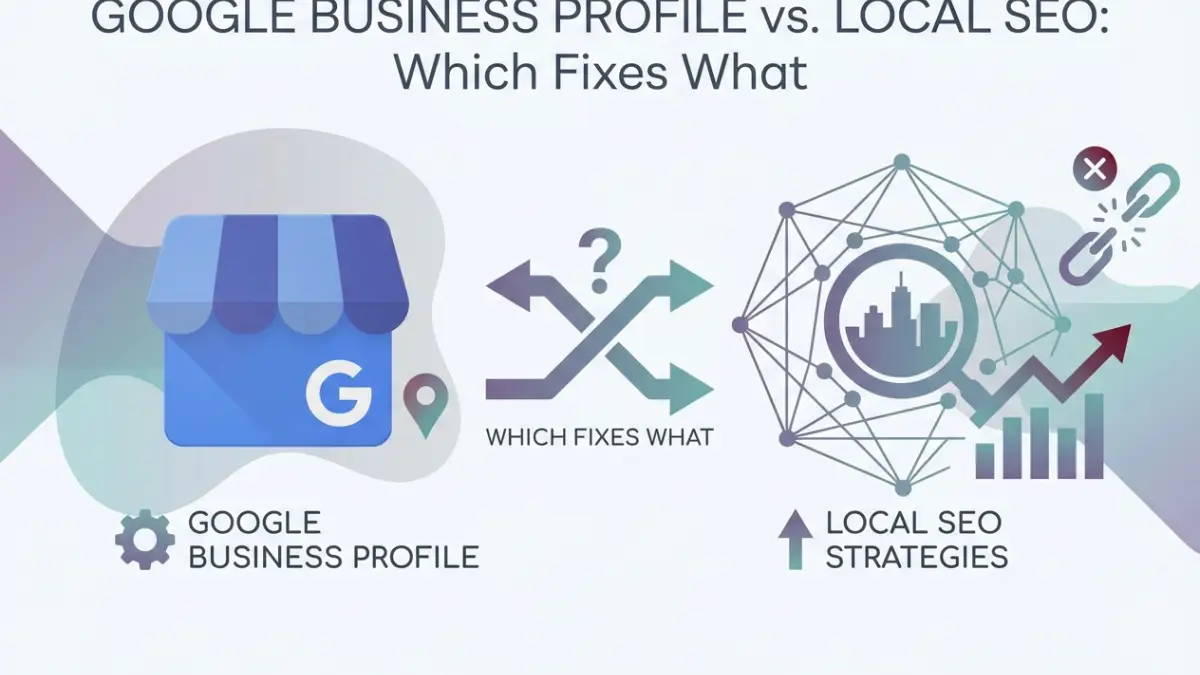
Most businesses do not need a Google Business Profile. They need customers. That gap is why so many buyers confuse a Google Business Profile with local SEO. The profile is one asset inside a broader local visibility program, not the program itself. If you purchase profile help expecting leads to rise on their own, you may be paying for a fraction of the work the outcome requires. This post disambiguates the terms and shows what each one actually fixes. We will cover what a Google Business Profile refers to, what local SEO optimization includes, how their scopes compare, what a profile engagement can and cannot fix, and why a profile without a program stalls. We will also address restricted categories, intelligent buying, and how to measure the profile versus the program. If you are evaluating a Google Business Profile for local SEO, start here. One is an asset. The other is the system that makes it perform.
What a Google Business Profile Actually Refers To
A Google Business Profile is a business listing that appears on Google Search and Maps. Google's own documentation frames it precisely: you can use your profile to improve your local ranking. That is the whole argument: a tool, not a strategy.
Google documents specific levers behind that tool:
Verification. Tells Google the business is authorized to represent itself, making it more likely to appear in search results.
Complete, accurate information. Address, hours, primary category, attributes. Google notes inaccurate info can prevent a profile from appearing for relevant searches at all.
Review responses. Google frames replies as signaling that the business values customer feedback.
Photos and videos. Positioned as a way to tell the business's story.
In-store product listings. Limited to retail businesses in eligible countries or regions.
Google also states there is no way to request or pay for a better local ranking. Money buys work on the levers above, not placement.
A Google Business Profile for local SEO therefore describes one input into local SEO, not the discipline itself. It is not a strategy, not a campaign, and not a local visibility program. It is one asset inside a broader effort, which is why Google Business Profile now functions as front-line infrastructure for many brands.
What Local SEO Optimization Actually Covers
Local SEO optimization is the full set of work that makes a business findable, credible, and chosen within a geography, across Google and beyond. The profile is one participant in that program, not a synonym for it.
Technical and on-site. Site architecture, dedicated location and service pages, page speed, and mobile experience determine whether search engines can crawl the site and buyers can act on it. Structured data helps search engines understand what the business does and where. For multi-location brands, multi-location Google Business Profile management keeps this layer consistent at scale.
Content. Pages and posts built around the queries real buyers type expand the surface area a business can be found on. Local content should reflect the actual service area, not a generic template.
Credibility. Business information must be represented consistently across the web. Review generation and review response are managed as ongoing processes, not a one-time cleanup.
Conversion and retention. This is where local visibility turns into revenue: the site experience, the booking or contact path, and the follow-up that keeps a first-time customer. ELM builds this layer inside its broader system of strategy, web design, content, local SEO, profile optimization, conversion, acquisition, and retention.
The profile sits under local SEO optimization, not beside it.
Side-by-Side Scope: What Each One Includes and Excludes

Google Business Profile engagement covers one asset: category selection, business information accuracy, verification, photos, review responses, and profile-level insights. A local SEO program includes that asset plus site, content, credibility signals, and conversion path.
Ownership and risk differ. The profile is Google-controlled, governed by rules you do not set. Google may restrict or suspend it for violations; restrictions can cascade across linked accounts. Site, content, and review pipeline are assets you own and can build indefinitely, like building a local affiliate program for a service-area business.
Cadence differs. Profile work is front-loaded setup with lighter maintenance. Program work is ongoing because content, reviews, and site improvements compound. A one-time fee and a monthly retainer are not competing bids for the same deliverable.
Reviews, categories, photos, and attributes appear in both conversations. That overlap is where confusion starts. The profile captures local intent; the program generates, feeds, and converts it.
Dimension | Profile Engagement | Local SEO Program |
|---|---|---|
Scope | One asset | Asset plus site, content, credibility, conversion |
Deliverables | Setup, verification, categories, photos, review responses | Above plus pages, reviews engine, tracking |
Ongoing effort | Light maintenance | Ongoing by design |
Ownership | Google-controlled, suspendable | Business-owned, compounding |
Can influence | Visibility for existing demand | Demand generation and conversion |
The program contains the profile, not the reverse.
What a Profile Engagement Fixes and What It Cannot
Scope settled, the useful question becomes what a profile engagement actually moves.
What it fixes: eligibility to appear, accurate and current information, correct primary category, credibility at first glance, and a buyer's ability to act immediately from Maps or Search.
What it cannot fix: it does not create demand that isn't already there, and it does not widen the range of searches the business can compete in beyond what the profile supports. Those are program-level problems.
The biggest hidden gap sits past the click. A well-optimized profile that sends traffic to a slow, thin, or confusing site loses the attention it just earned, because the profile can win attention it has no way to convert.
Decay is the second gap. Without a review generation process and steady content, profile signals flatten. A one-time optimization is a starting position, not a durable one. As covered in Organic as Infrastructure: Local SEO, Google Business Profile, and AI Search, the profile compounds only when the system behind it keeps feeding it.
Google documents that there is no way to request or pay for a better local ranking. Any vendor promising paid placement is not describing something Google supports. The honest framing: a profile makes existing demand visible. It does not manufacture it.
Why a Profile Without a Program Stalls
This is ELM's position, grounded in mechanism rather than a study. No research base here measures profile-only engagements, so treat what follows as an explanation, not a finding.
Visibility without a destination. The profile can surface a business to a buyer already searching. If no page answers that specific need and converts it, the attention evaporates.
A confined competitive space. A profile competes inside a narrow set of results for a limited set of queries. The broader program, through content and site structure, expands the set of queries a business can plausibly win.
No review engine. Reviews need a system generating them: the customer experience, the ask, and the follow-up. That system lives in the program, not the profile. For fitness and wellness brands, Elmtmarketing builds this system for your gym, wiring follow-up into review generation instead of leaving it to chance. Without it, the profile slowly loses the trust signals that made it useful.
No measurement beyond profile insights. In our observation, profile-only engagements tend to show their strongest early movement and then plateau, a pattern buyers describe as "it stopped working," though no published study we are aware of formally tracks this. Profile insights show views, calls, and direction requests, visibility data that does not show whether those contacts became customers, which is the number the buyer actually paid for.
Restricted Categories: What Changes for Fitness, Wellness, Music, and 21+ Brands
That plateau is worse in restricted categories, where policy shapes the plan before optimization starts. Smoke, hemp, and adult beverage brands face eligibility and category questions that general local SEO advice ignores. Confirm each client's specifics against Google's published policy at the time of the engagement, not from memory or a template.
Age-gating and content rules may shape what imagery, offers, and language are permissible on a profile, confirm the specifics against Google's current published policy before building any plan.
In-store product listings are not a realistic lever for most of these brands, so scrutinize any proposal built around them.
Reviews are where compliance gets sharpest. Google prohibits paid or incentivized reviews and bars soliciting a set number or specific content, which makes a written policy for what a business asks, how it responds, and what it never says publicly non-negotiable.
This is where category fluency matters. ELM Tree Marketing works with fitness, wellness, music, and 21+ brands as a matter of course, and treats policy confirmation as part of the engagement. For one adjacent example, see this recommended approach to dispensary SEO.
How to Buy Intelligently
Policy checks settled, the buying question remains: what are you actually purchasing? Ask any provider: Does this fix the site or only the profile? Who writes and publishes content? What happens in month two and month six? Which metrics get reported, and why?
Avoid packages priced as if profile work were the entire engagement and proposals that never name the destination page profile traffic will land on.
A legitimate profile engagement covers verification, category and attribute accuracy, a photo and update plan, review response, and reporting on the profile's own engagement metrics.
A full local program adds site and page work, content built around real queries, consistent business information across the web, review generation, and conversion tracking tied to leads rather than views.
ELM Tree Marketing sits in the second category: profile optimization is one component inside a broader revenue system, not a standalone product. For restricted categories, that distinction matters, as covered in Full-Service Agency vs. Cannabis SEO Vendor: Why the Difference Matters. Judge which shape matches your outcome.
Measuring the Profile Versus Measuring the Program
Every quote deserves two scorecards, and only one of them is a revenue scorecard.
Profile-level signals, calls, direction requests, website clicks, and messages, describe attention, not outcomes. According to Google's Business Profile performance documentation, this data covers views, searches, and actions from organic results and Ads combined, so it blends paid and organic activity. It also surfaces the search terms that triggered the profile, though the data updates at the start of each month and can take up to five days to appear. Useful as a pulse, not as a P&L.
Program-level signals describe revenue: qualified leads, conversion rate by landing page, completed bookings or orders, and cost per acquired customer. Buyers comparing quotes should insist on this set.
The boundary matters. The profile can influence visibility for demand that already exists and remove friction at the moment of contact. It cannot create demand, close the sale on your site, or retain the customer afterward.
Before any work begins, baseline your current numbers: call volume, form submissions, and review count and velocity, so improvement has something to measure against. Add attribution hygiene from day one with call tracking numbers, tagged links, and a form field that names the source. Without it, profile insights and program results get argued about rather than compared.
The most common error is judging an entire local program on profile insights alone. That makes a functioning program look idle and a stalled profile look like the whole story.
The Short Version: One Is an Asset, the Other Is the Program
Measurement separates attention from revenue. Scope separates an asset from a program.
A Google Business Profile is one asset inside a local visibility program. Local SEO optimization is the program. Buying the first while expecting the second is the mismatch behind many unmet expectations.
So audit what you already have, confirm what your current provider actually touches, and write down the outcome you want before comparing quotes. The four buying questions in the section above are the quickest test.
Treat the profile as the entry point, not the finish line, it compounds only when the system behind it keeps feeding it.
If you want the program rather than the fraction, ELM Tree Marketing builds profile optimization as one component of a structured revenue system for fitness, wellness, music, and 21+ brands.

Conclusion
Ready to build the program rather than just the profile? Measurement must connect profile activity to revenue, not just views or calls. Contact ELM Tree Marketing for a structured local revenue system tailored to fitness, wellness, music, and 21+ brands. Start with clarity; finish with measurable growth.
FAQ
What is the difference between a Google Business Profile and local SEO?
A Google Business Profile is a business listing that appears on Google Search and Maps. It is one asset inside a broader effort. Local SEO optimization is the full program that makes a business findable, credible, and chosen within a geography, covering site architecture, content, credibility signals, and the conversion path. The profile sits under local SEO, not beside it.
Can paying for Google Business Profile help guarantee a higher local ranking?
No. Google states there is no way to request or pay for a better local ranking. Money buys work on the profile's levers, such as verification, accurate information, categories, photos, and review responses, but not placement. Any vendor promising paid placement is not describing something Google supports.
What can a Google Business Profile engagement fix, and what can it not fix?
A profile engagement can fix eligibility to appear, accurate and current information, the correct primary category, credibility at first glance, and a buyer's ability to act immediately from Maps or Search. It cannot create demand that does not already exist, widen the range of searches a business can compete in, or convert visitors once they reach a slow or confusing website. Those are program-level problems.
Why does a Google Business Profile stall without a broader local SEO program?
A profile can surface a business to buyers already searching, but without a page that answers their need and converts them, the attention is lost. It also competes in a narrow set of queries, lacks a system to generate reviews, and reports only visibility data such as views, calls, and direction requests rather than whether those contacts became customers. Without ongoing content and reviews, profile signals flatten over time.
How should I measure a Google Business Profile versus a full local SEO program?
Measure the profile with its own signals, such as calls, direction requests, website clicks, and messages, which show attention rather than outcomes. Measure the program with revenue signals: qualified leads, conversion rate by landing page, completed bookings or orders, and cost per acquired customer. Before work begins, baseline current call volume, form submissions, and review count and velocity, and use call tracking numbers, tagged links, and source fields for attribution.