
Trials, Memberships, and Class Packs: Choosing the Offer That Builds Retention
- Doc. N°
- ELMTM-059
- Filed
- Class
- Fitness
- By
- ELM Tree Marketing
- Read
- 11 min
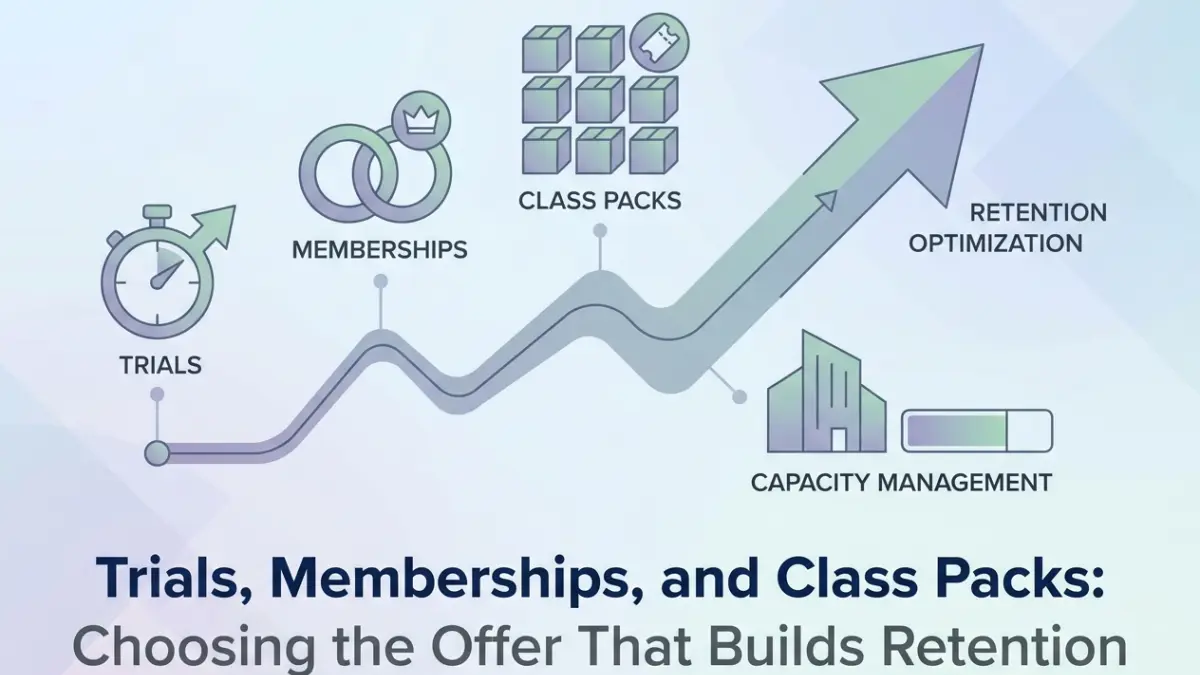
The offer you sell is not a signup tactic. It is a retention decision. Free trials can fill a calendar with prospects, but volume does not reveal who will stay. Memberships filter for fit and commitment. Class packs serve specific audiences with shorter horizons. If your fitness center marketing plan treats all three as interchangeable, you will optimize for the spike and pay for it in churn.
This post compares trials, memberships, and class packs by retention math, not raw lead count. You will see why the offer shapes who walks in and how long they stay. The sections ahead cover The Offer You Sell Is the Marketing Decision; Free Trials: Volume Without Commitment; Memberships: Rewarding Fit Over Enthusiasm; Class Packs: Built for Specific Audiences and Shorter Horizons; A Side-by-Side Comparison on Retention Math; Which Offer to Lead With; Capacity Bands at Low, Mid, and High Fill; Member Mix; Where the Offer Fits in a Fitness Gym Marketing Plan; and Choose the Offer by the Retention Math, Not the Signup Spike. By the end, you will have a practical framework for choosing the offer that builds retention.
The Offer You Sell Is the Marketing Decision
Most operators treat the offer as a promo decision: which discount, which month. That misses its real function. Offer structure settles three things at once: commitment level, fit filtering, and capacity consumed per signup.
Signup spikes feel like growth. Retention math compounds: expected tenure times margin per member, weighed against acquisition cost and capacity used. Meanwhile, first-six-month dropout runs 40 to 65 percent, per peer-reviewed research hosted by the NIH. Use that as context, not a forecast for your club.
A 2019 HFA (formerly IHRSA) featured piece, vendor-sponsored and now roughly seven years old, framed attrition as a threat to long-term financial health. It supports the premise without serving as a current benchmark.
Much of the public retention conversation is shaped by software vendors promoting a tooling fix. Offer decisions sit upstream, which is why email marketing for gyms cannot rescue an offer the market will not keep. Strategy belongs to the operator.
Offer selection is the highest-leverage line in a fitness center marketing plan, ahead of ad budget, creative, or channel mix. It decides who your ads can attract at all. The Email Marketing for Gyms: Retention-First Playbook treats follow-up as downstream of that choice. The offer you sell decides who walks in and how long they stay.
Free Trials: Volume Without Commitment
A trial is the widest front door and the weakest filter. It attracts high-intent researchers and comparison samplers, including the person running three studios in the same month. Low friction maximizes volume and the number of people with no stake in your schedule.
Commitment is close to zero. The trial asks for time, not money or a recurring decision, so attendance is optional and the exit requires only silence.
Capacity load is front-loaded and uneven. Trial traffic consumes class slots, coach attention, and onboarding labor during the same hours paying members are competing for them.
Conversion depends entirely on a tight, timed follow-up sequence. Without one, the trial becomes a free sampling program funded by your payroll.
Trials earn a place in narrow situations: a new location launch, a new format you need to demonstrate, or a market where nobody knows your name. Pair the offer with a defined next step and a deadline, never an open invitation.
The practical guardrail is a cap. Limit trial volume by week and by hour so trial traffic cannot crowd the classes your members already pay to attend.
Memberships: Rewarding Fit Over Enthusiasm
If a trial filters for curiosity, a membership filters for intent. Its recurring price screens out the experimenters before the first visit and attracts people who want a routine and a place.
Commitment is a standing decision; the first 90 days carry the highest churn risk.

In practice, memberships screen out people who do not match your schedule, format, and culture. Enrollment-stage factors predict one-year termination, so the people who sign tend to be the people who stay. Volume drops, but the denominator is better.
Capacity load is predictable and spread across the month, which makes staffing, class planning, and revenue forecasting far easier than trial or pack traffic allows.
Retention implication: memberships produce the longest expected tenure of the three, but only when onboarding, habit formation, and a visible reason to return exist. A membership with no onboarding simply delays a cancellation rather than preventing it.
Pricing note: an underpriced membership attracts price-sensitive members who churn on the first dues increase. A price aligned to your positioning does the filtering work for you.
Class Packs: Built for Specific Audiences and Shorter Horizons

Not every qualified buyer wants a standing commitment. Packs serve episodic audiences: new parents, shift workers, seasonal athletes, drop-in travelers, and corporate groups. These are buyers who will not sign a recurring contract but will prepay for a set number of visits.
Commitment lands in the middle. The buyer has already paid, so there is real reason to show up before the pack runs out, more pull than a free trial creates. Expiration drives repeat visits and creates a cliff: the drop-off happens when the pack ends, not when motivation fades, which makes the expiration date your conversion deadline.
Capacity load is partially self-regulating, since pack holders ration sessions to stretch value. Watch for end-of-pack booking spikes that squeeze regular members in popular time slots.
Packs fit buyers who will not commit monthly, and they work best as a bridge into membership rather than a destination. An expiring pack with no conversion path is a completed relationship, not a retained member.
In some operations, pack holders attend more consistently in the final weeks of a pack than some monthly members do in any given month, test this in your own data.

A Side-by-Side Comparison on Retention Math
Here is the scorecard.
| Factor | Trial | Membership | Pack | | Filters for | Curiosity; weakest filter | Commitment; strongest filter | Episodic need; moderate filter | | Commitment | Time only; near zero | Recurring; standing decision | Prepaid visits; moderate | | Capacity per buyer | High, front-loaded | Predictable, spread out | Self-regulating; end spikes | | Expected tenure | Shortest | Longest | Ends at expiration | | Churn trigger | No follow-up | Weak onboarding | Pack exhaustion |
Read the matrix as retention math. Trials widen the top of the funnel and weaken the filter, which raises service cost per converted member and shortens average tenure. Memberships narrow the funnel and strengthen the filter, producing the most predictable capacity load and the longest tenure. They convert fewer people and keep more of them. Packs sit in the middle: moderate reach, moderate filtering, and tenure that ends with the expiration date on the card.
Conversion rate alone is misleading. A trial can post a respectable conversion rate and still lose money once staff time, onboarding labor, and short tenure are counted against revenue. Do not run all three offers at once without a designed sequence. That creates a crowd that sampled everything and committed to nothing, plus a service bill you cannot trace to revenue.
Which Offer to Lead With
Retention math narrows to one front door. Choose it by capacity and member mix, not by which offer is easiest to promote.
Lead with memberships when capacity is predictable, onboarding is repeatable, and your audience values routine over novelty. Lead with class packs when the audience is episodic, meaning seasonal, shift-based, or drop-in, or when scheduling and staffing cannot absorb a wave of recurring commitments. Lead with trials only to demonstrate something new or seed a new location, and only when a defined next step and a firm deadline are attached. An open-ended trial is a giveaway, not a funnel.
Never lead with all three. Pick one front door, then route the other two as sequenced steps inside the customer journey. In the author's experience, two paths work: trial to pack to membership for cautious buyers, and pack to membership for episodic buyers.
Expect internal pressure on this decision. The offer with the loudest signup week is rarely the one paying the lease twelve months later. One front door, sequenced exits.
Capacity Bands: What to Lead With at Low, Mid, and High Fill
Capacity bands turn the general rule into a specific decision.
Under 50 percent filled. Lead with trials and packs. They fill dead hours and build awareness at low cost, because unused capacity is the one asset you cannot bank for later.
50 to 80 percent filled. Lead with memberships. Recurring revenue matches the fixed cost of staffing and rent, and the room still has room to absorb new members without crowding anyone out.
Above 80 percent filled. Restrict trials and cap pack sales. Promotional volume at this level costs you member experience and pushes paying members out of the classes they signed up for.
Segment by time of day, not by gym total. A packed 6 a.m. class should not run a trial promo while the 2 p.m. slot sits empty.
Measure cost per retained member, not cost per lead, before scaling any offer. Cost per lead will always flatter the trial.
Fill rate only tells half the story. Who fills it tells the other half.
Member Mix: Matching the Offer to Who Actually Shows Up
Fill rate tells you when to run each offer. Member mix tells you which one the people in front of you will keep.
Goal-driven, schedule-stable clients want progression, accountability, and a standing place in the room. Route them to memberships.
Episodic or project-based clients buy around an event, a season, a recovery window, or a short training block. Packs fit that horizon.
Price-shoppers and serial samplers rarely convert without a strong onboarding hook. Admit trial traffic deliberately and budget staff time for it.
Adjacent audiences split further. Corporate wellness groups, post-rehab referrals, and 21+ social wellness brands each accept a different commitment level, so no single offer serves all three. They also open partnership channels across health and wellness audiences.
Pull 12 months across all three offers and compare visits per buyer, revenue per visit, and service cost per visit, the same three numbers referenced throughout this guide.
Where the Offer Fits in a Fitness Gym Marketing Plan
The offer is the first line of your fitness gym marketing plan. Ads, content, and local search compound only when anchored to the right offer.
Match channel to offer. Trials answer broad-reach paid social and sampling. Memberships answer trust-building content, reviews, and Google Business Profile work. Packs answer niche targeting and seasonal timing.
Capture high-intent searches through local SEO and Google Business Profile optimization, then route each searcher to the offer they will keep, not the lowest entry price.
Time follow-up to attendance data. A trial who showed up three times in week one is a membership prospect; one visit is a re-engagement email in your retention-first email playbook.
Tactics still leak without infrastructure, which is why individual tactics fail without a connected marketing system.
ELM Tree Marketing, a Houston-based performance marketing agency, builds offer-first revenue systems for fitness, wellness, music, and 21+ brands across strategy, website design, content, local SEO, and retention. It is one option among several; the framework works with or without an agency. Apply here.
Hold the plan to one number: retained revenue per acquisition dollar, reviewed monthly, by offer.
Choose the Offer by the Retention Math, Not the Signup Spike
The front-door choice, memberships for routine, packs for episodic audiences, trials for new launches with a deadline, was covered above; here is the sequence to make it operational.
Run the three-number audit described in the Member Mix section.
Connect the offers so none dead-ends. Trial to pack, pack to membership, with a timed follow-up triggered by attendance data rather than a calendar.
Put the capacity rule from the Capacity Bands section in writing before the next promo.
Re-check the mix quarterly. Member mix and fill rates shift, so the offer that led last quarter is not automatically the right one now.
Conclusion
The offer you lead with is a retention decision, not a signup contest. Run the one-front-door decision, the three-number audit, and the sequenced path from the sections above. Track retained revenue per acquisition dollar, by offer, every month. If you want help building that offer-first system, apply here. Choose the offer by the math, and let retention compound.
FAQ
Why should a gym choose its offer based on retention math rather than signup volume?
Signup spikes feel like growth, but retention math compounds. It weighs expected tenure times margin per member against acquisition cost and capacity used. A trial can produce many leads yet still lose money once staff time, onboarding labor, and short tenure are counted. The offer determines who walks in and how long they stay, so it should be chosen for the members it keeps.
How do free trials, memberships, and class packs differ in how they filter buyers?
Free trials are the widest front door and the weakest filter, attracting curiosity with near-zero commitment. Memberships filter for intent through a recurring price, producing the longest expected tenure when onboarding is strong. Class packs serve episodic audiences who prepay for a set number of visits, with moderate filtering and tenure that ends at pack expiration.
Should a gym run all three offers at the same time?
No. Running all three at once creates a crowd that sampled everything and committed to nothing, plus a service cost that is hard to trace to revenue. The recommended approach is to pick one front door and route the other offers as sequenced steps in the customer journey, such as trial to pack to membership or pack to membership.
Which offer should a gym lead with based on its fill rate?
Under 50 percent filled, lead with trials and packs to fill dead hours and build awareness at low cost. Between 50 and 80 percent filled, lead with memberships, since recurring revenue matches fixed costs and there is room for new members. Above 80 percent filled, restrict trials and cap pack sales so promotions do not crowd out paying members. Segment these decisions by time of day rather than by gym total.
What metric should gym operators track to evaluate each offer?
Operators should measure cost per retained member rather than cost per lead, since cost per lead will always favor trials. Monthly, review retained revenue per acquisition dollar by offer. Also compare visits per buyer, revenue per visit, and service cost per visit across all three offers over 12 months to see which offer actually sustains revenue.