
Rented vs. Owned Audience: Streams Can't Carry a Career
- Doc. N°
- ELMTM-057
- Filed
- Class
- Music
- By
- ELM Tree Marketing
- Read
- 11 min
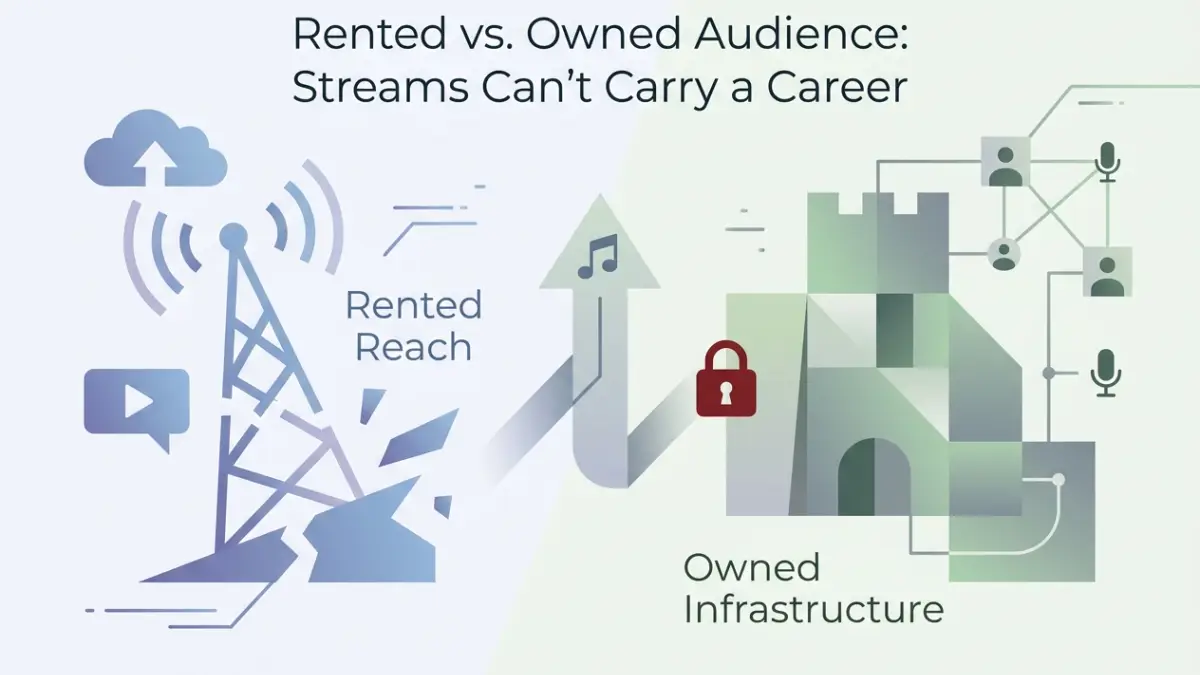
Streaming numbers can make an artist look successful while leaving them unable to contact a single listener. That gap sits at the center of a career problem: a rented audience is not the same as an owned one. This post separates platform-audience growth from a direct fan relationship, and it explains why streams, followers, and algorithmic reach behave like rented space while email lists, SMS lists, direct sales, and first-party data are assets you actually control. We will define each audience type, compare rented reach with owned infrastructure side by side, and identify where artists confuse a follower count with a fan base. You will also see why streams alone cannot carry a career, what rented reach is genuinely good for, what an owned audience does better, and how the algorithm change test exposes the difference. We will cover how to build both without splitting your focus, plus consent, privacy, and restricted categories. Throughout, the practical lesson is clear: use direct-to-fan platforms to turn borrowed attention into relationships you can reach again. Rent reach, own the relationship.
What a Rented Audience Actually Is
A rented audience is the reach you access through someone else's platform: streams, followers, subscribers, algorithmic reach, and platform-mediated discovery. You get entry to the audience, never ownership of it.
The mechanics are simple. The platform sets the reach, the feed decides who sees the work, and the artist pays for access with release frequency, posting cadence, or ad spend. IFPI's Global Music Report 2025 frames labels as connectors who help artists cut through enormous content volume, which confirms access is mediated by an intermediary. The same report quotes an executive on the constant pressure to stay visible in a digital spotlight and cites more than one million tracks released weekly. Treat that figure as an executive estimate, not an audited dataset.
That pressure is one reason creator and community marketing outperforms polished ads. Rented reach can be huge and fast, but it is always conditional on terms the artist does not write.

What an Owned Audience Actually Is
Beyond reach you rent, there is a second audience you can actually hold: one that is addressable, exportable, and directly contactable. That includes an email list, an SMS list, a Discord or community you control, direct-to-fan sales, and first-party purchase data.
The Three Tests of Ownership
Reach: can you contact this person without paying a platform?
Export: can you pull the contact record out of the tool? Data portability rights support this test.
Consent: can you contact them again without an algorithm's permission? Electronic marketing rules generally require it, with narrow exceptions such as soft opt-in.
Direct-to-fan platforms are the infrastructure layer: storefronts, email and SMS tools, community apps, and pre-order or drop systems that keep fan data on your side of the transaction. Owned does not mean fee-free or risk-free. It means the relationship survives swapping any single tool.
This comparative thesis is a strategic argument, not a proven statistical claim; research on list durability and repeat purchase rates remains thin.
Side by Side: Rented Reach vs. Owned Infrastructure
Rented reach wins on discovery speed: one track reaches people no email list of a few thousand will ever touch. Owned infrastructure wins on margin and retention, because a fan on your list does not need re-earning by a feed ranking. That is why the comparison belongs in cost per reader, not cost per impression. Rented reach holds the same result only through continuous spend or continuous output.
Dimension | Rented | Owned |
|---|---|---|
How you reach them | Feed, playlist, paid ads | Email, SMS, direct store |
Who controls rules | The platform | You |
What data you keep | Aggregate metrics | Contacts, purchase history |
Cost per contact | Rises with each release | Falls as the list compounds |
Policy change risk | Immediate reach loss | Stays intact |
Repeat purchase | Re-earned by the feed | Direct ask |
This is a strategic comparison, not a verdict on streaming. Rented reach feeds the top of the funnel; owned infrastructure converts it. MIDiA tracks the artists direct segment separately, a signal that fans will buy outside the feed when given a reason.
Where Artists Confuse the Two
Cost per reader explains the economics. The confusion itself is a labeling problem, and four errors recur.
The follower fallacy. A large following is a borrowed number attached to an account. It is not a roster you can email, sell to, or call on to fill a room.
The stream fallacy. Millions of plays can produce a listener file the artist never receives. The commercial relationship ends when the play ends.
The playlist substitution error. Editorial or algorithmic placement gets treated as audience building. It is rented exposure, revocable without notice.
The Discord error, reversed. Owning the channel is not owning the audience if the contact record lives inside someone else's product with no export.
Then run the audit: subtract every follower, subscriber, and stream. Count the people you could email or text tomorrow with a real offer. That number is your actual audience, and it raises the next question.
Why Streams Alone Can't Carry a Career
Once you run that self-audit, the gap becomes a strategic problem, not just a bookkeeping one. The IFPI Global Music Report 2025 notes recorded music revenue has grown for a decade, but growth in the latest reported year was slower than in recent years. For an artist planning a next release, that deceleration matters more than the direction.
A growing market can still compress your share of it. An executive quoted in the same report cites more than a million tracks released weekly, an estimate rather than an audited figure. At that volume, attention fragments even as revenue rises.
Meanwhile, streaming pays per play, while visibility demands steady, higher-frequency releases. Production and marketing costs climb against a relatively flat per-stream rate.
Fragility compounds the math. A policy change, catalog reclassification, or feed ranking shift can cut reach overnight, with no change in artistic quality.
IFPI supports the pressure and volume side of this case. Owned-list durability remains a strategic thesis needing independent research, not a proven statistic.

What a Rented Audience Is Genuinely Good For
That fragility does not make rented channels useless. They remain the cheapest place to introduce a stranger to a song for the first time. A viral clip or playlist add creates the first touchpoint, which owned infrastructure then converts into a contact. Real-time engagement also acts as market research: it shows which songs, cities, and clips have momentum, so you know where to deploy spend next, including paid channels that work for restricted categories. Strong platform numbers still carry commercial weight in booking, brand deals, and label conversations, even when the underlying relationship belongs to the platform. The practical rule is simple: treat rented channels as acquisition, never as the asset. Send every spike, every view, and every save toward a contact capture step: email, SMS, or a direct-to-fan offer. Rent the reach; route the relationship.
What an Owned Audience Is Genuinely Good For
Once that attention is captured, the economics change. A fan buying a shirt, a vinyl variant, or a ticket through your own checkout returns more per head than a stream. Physical format revenue rose 8.0% in 2025, with vinyl up 13.7%, confirming fans still pay for tangible goods. Pre-orders and merch bundles work because the list can be contacted repeatedly without re-earning the feed. You announce, remind, and follow up on your schedule instead of hoping the algorithm resurfaces the release on day four. First-party purchase data, knowing who buys, from where, and how often, turns release planning into something closer to forecasting. And resilience: the list, the buyer file, and the contact record persist across tool changes. That is the exact property rented reach lacks.
The Algorithm Change Test
If a platform changed its ranking, throttled a format, or updated policy tonight, what would you still have tomorrow morning?
Rented answers shrink immediately. Impressions, follower reach, and organic discovery reset to whatever the new rules permit. Nothing you published yesterday guarantees access today.
Owned answers hold. A list of a few thousand email subscribers is unchanged by a ranking update and can be contacted the same day at effectively zero marginal cost.
Now run the account-level version: if your main account were disabled tomorrow, how much of your audience could you reach within 24 hours? For most artists, the honest number is small.
This matters more in restricted categories. Smoke, hemp, and adult beverage brands face stricter platform rules, and rented reach can be constrained or removed outright. Treat that as directional until platform policy sources are documented.
That gap is the whole argument. Next, how to build both without splitting focus.
How to Build Both Without Splitting Your Focus
Once you know what survives an algorithm change, connect the engines. Rented content creates the first touch; one clear call to action per release moves the fan into an owned channel. Do not present five offers. Make the capture worth it with early access, a presale code, a voice memo demo, or a limited physical variant.
Choose direct-to-fan platforms deliberately. Compare contact records, export, fees, and deliverability, then verify fan data remains accessible outside the tool. Treat owned audience as the retention engine and rented channels as the acquisition engine. Agencies that build structured revenue systems, like ELM Tree Marketing in Houston, run this as one connected funnel, not two campaigns.
Measure the handoff: capture rate per release, list growth per city, and revenue per subscriber. As with building an affiliate program that actually performs, the numbers reveal whether rented attention is becoming an owned asset.
Consent, Privacy, and Restricted Categories
The funnel only works if the contact data in it was collected legally. Collect fan emails and phone numbers with clear consent and an easy opt out. Most markets require a documented lawful basis for outreach, and a purchased or scraped list does not qualify. Phone and SMS consent follows its own rules, including the TCPA in the United States.
Verify requirements against primary guidance from the FTC, the ICO, or your national privacy authority rather than secondhand summaries. Rules vary by market and are subject to change, so confirm the current version before publishing a claim.
Keep the record clean: store source, date, and the exact consent language next to each contact, so you can prove how the relationship began.
For smoke, hemp, and adult beverage brands, assume stricter platform rules and build owned channels as the primary commercial path rather than a backup. Compliance-aware messaging is part of that build, as outlined in E-E-A-T and Compliance-Aware Content: The New Ranking Standard.
Finally, flag any deliverability, conversion, or list durability claim that lacks a primary source, and resolve it with data before publication.
The Takeaway: Rent Reach, Own the Relationship
With consent and clean records in place, the strategic question is simple: which audience do you actually own? Run the 24-hour test this week. Count every fan you could email or text tomorrow without a platform's help. That number is your real audience. Next, pick one capture offer tied to your next release and place it everywhere you already rent attention: shorts, playlist pitches, live shows. Then choose direct-to-fan platforms that let you export contact records, and verify that export works before you need it. Track revenue per subscriber alongside stream counts, so rented attention is measured by what it produces, not what it displays. The mechanics mirror how Elmtmarketing builds this system for your gym: capture, contact, convert. Build both, but treat only one as the asset. Rented reach buys discovery; owned audience buys the career.
Conclusion
Streams rent attention; they do not build a career by themselves. Rented reach is useful for discovery, but an owned audience, email and text contacts you can export and contact directly, is the asset that compounds. Build both without splitting your focus: capture contacts everywhere you already earn attention, keep consent and clean records, and track revenue per subscriber alongside play counts. This week, run the 24-hour test. Count the fans you could reach tomorrow without a platform. Then launch one capture offer tied to your next release and verify your direct-to-fan platform lets you export those records. Rent reach. Own the relationship. That is how streams become a career.
FAQ
What is the difference between a rented audience and an owned audience?
A rented audience is reach you access through someone else's platform, such as streams, followers, subscribers, and algorithmic reach. You get access but never ownership. An owned audience is one you can contact directly and export, such as an email list, SMS list, Discord or community you control, direct-to-fan sales, and first-party purchase data. The platform controls the rented audience, while you control the owned one.
How do I know whether my follower count reflects a real fan base?
Run the audit: subtract every follower, subscriber, and stream from your count, then count the people you could email or text tomorrow with a real offer. That remaining number is your actual audience. Followers are a borrowed number attached to an account, not a list you can email, sell to, or call on to fill a room.
Can I still rely on streaming and social platforms if I build an owned audience?
Yes. Rented channels are the cheapest way to introduce a stranger to your music for the first time and to gauge which songs, cities, and clips have momentum. The recommended approach is to treat rented channels as acquisition, not as the asset, and route every spike, view, and save toward a contact capture step such as email, SMS, or a direct-to-fan offer.
What is the algorithm change test?
The algorithm change test asks what you would still have tomorrow morning if a platform changed its ranking, throttled a format, or updated its policy tonight. Rented reach such as impressions and organic discovery resets to whatever the new rules allow, while an owned email list remains intact and can be contacted the same day. A variation of the test asks how many fans you could reach within 24 hours if your main account were disabled.
How do I build an owned audience legally and without losing focus?
Offer one clear capture incentive tied to each release, such as early access, a presale code, a voice memo demo, or a limited physical variant, and collect contacts only with clear consent and an easy opt-out. Purchased or scraped lists do not qualify, and SMS consent follows its own rules, such as the TCPA in the United States. Store the source, date, and exact consent language with each contact, and verify current requirements with primary guidance from authorities like the FTC, the ICO, or your national privacy regulator, since rules vary by market and change over time.