
What Local SEO Covers in 2026: Maps, Organic, and the Surfaces Most Brands Ignore
- Doc. N°
- ELMTM-054
- Filed
- Class
- Local Search
- By
- ELM Tree Marketing
- Read
- 11 min
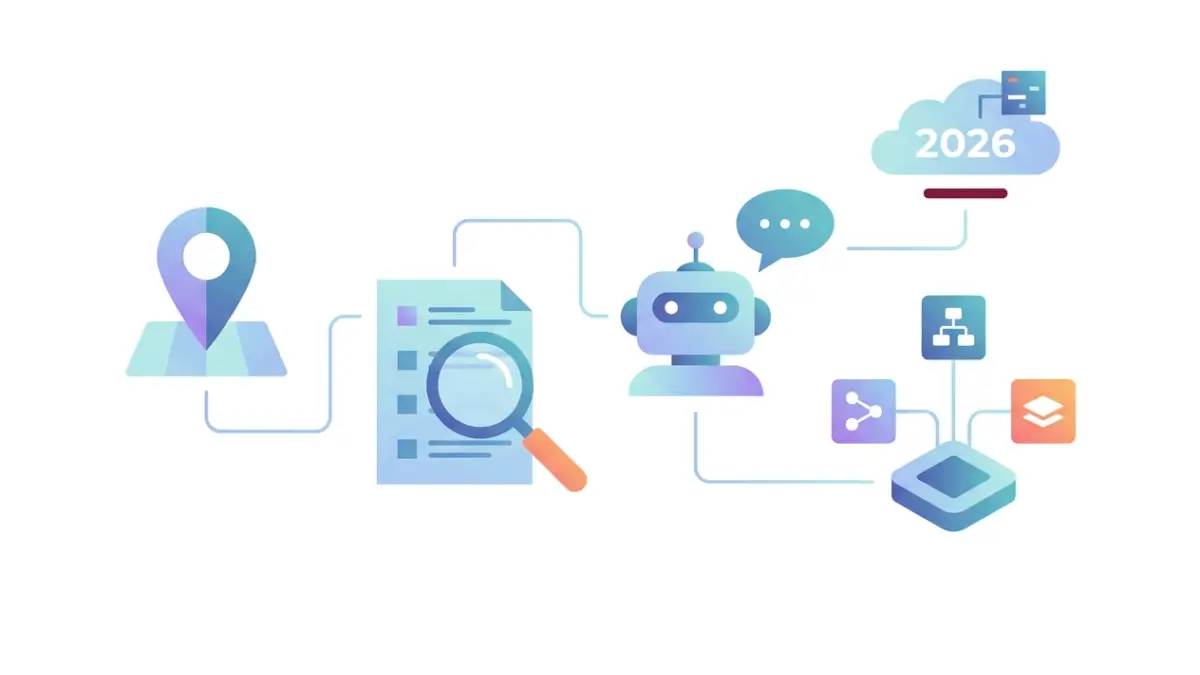
If you still measure local seo by where you rank in the map pack, you are looking at one window in a much larger building. In 2026, local search is not a single position. It is a set of surfaces where buyers encounter businesses: the map pack, organic local results, AI answers and AI Overviews, plus listings, reviews, and distribution platforms. Google itself describes local results as spanning Maps and Search, and each surface has its own ranking logic, content requirements, and failure modes. That means a brand can hold a strong map pack position and still lose demand in organic results, AI summaries, or third-party listings.
This tutorial resets the definition of local seo for intermediate practitioners. You will learn what local SEO actually covers in 2026, why local search split into separate surfaces, how to approach the map pack and Google Business Profile, organic local results, AI answers, and listings and reviews. You will also see why chasing only the map pack leaves demand unaddressed, what restricted and regulated brands must consider, and how to build full-surface local visibility.

What Is Local SEO? A Definition That Fits 2026
Local SEO is the practice of making a business discoverable and chosen across every surface a platform uses to answer location-based intent. It is not one ranking position.
Google's own guidance reflects that breadth. It states that customers find local results on both Maps and Search, and that Google tries to show "the kind of nearby business they'd like to visit" (Tips to improve your local ranking on Google). Plural results imply multiple formats, each won differently.
Four surfaces define the model:
The map pack and Google Business Profile (GBP): the three-business block in Maps and Search, powered by your GBP listing.
Organic local results: standard results for local-intent queries.
AI answers and AI Overviews: AI-generated summaries, sometimes resolving a query before a user clicks anything.
Listings, reviews, and citations: third-party platforms that corroborate your business data.
The root misconception is defining local SEO as "rank in the map pack." That definition pushes every downstream budget decision into one surface and starves the other three, a pattern that compounds for brands managing multi-location Google Business Profile management.
Why Local Search Split Into Separate Surfaces
The split happened because local search results stopped being one list. Rank tracking can show a position that actually sits below ads, a local pack, or an AI Overview, so the report looks healthy while the listing is never seen. Demand is real: 98% of consumers search online for nearby businesses and 80% do so weekly (2024 SOCi Consumer Behavior Index, second-hand via shno.co). Generative AI use for local recommendations rose from 6% to 45% in one year (BrightLocal 2026, as cited by shno.co), a directional shift. Reviews now act as trust data across surfaces: 97% read online reviews and 41% always read them, up from 29% (BrightLocal 2026, as cited by shno.co). Caution: most 2026 local SEO statistics circulate second-hand. Review share figures and the "nearly half of searches are local" claim are unresolved across sources. Cite originals, avoid settled language, and never state the "majority of demand" claim as fact. This fragmentation explains why a channel-first mindset keeps dispensaries stuck. For any local brand, the surfaces are separate and each is won differently.
Surface One: The Map Pack and Google Business Profile
The map pack is the surface most brands picture first: the three-business local pack that appears in Google Maps and Search, powered by the Google Business Profile (GBP). It is not the whole of local SEO. 42% of searchers click map pack results; 3-pack businesses earn 126% more traffic and 93% more actions than positions 4–10 (SOCi 2023 / Backlinko 2024 via shno.co), a real but narrow prize. That gap, not vague "majority" claims, defines the opportunity.
Completeness is a gate, not a bonus. Google states businesses with complete and accurate information are more likely to appear in local results, and inaccurate information may keep a profile from showing for relevant searches at all (Google Business Profile Help). There is also no paid shortcut: Google states "there's no way to request or pay for a better local ranking." Restricted-category brands should read that twice.
This surface is won through proximity, relevance, and prominence. In practice: choose the primary category carefully, populate services and attributes, add photos, answer Q&A, publish posts, and build review velocity. Treat GBP as front-line infrastructure, not a one-time setup. Finally, map pack visibility shifts with user proximity and can be disrupted by spam filters or profile suspensions. That volatility is why no brand should own only this surface.
Surface Two: Organic Local Results
The map pack is volatile, but it is not the only surface on the same results page. Organic local results are the standard blue-link listings that appear beside or below the map pack for the same local-intent query, and they include your service pages, location pages, and category content.
What wins here looks different from the map pack. Topical depth, city and service-area pages with genuinely differentiated content, internal linking, and LocalBusiness schema all matter. Pages that answer the specific questions behind local queries earn rankings. NAP consistency is table stakes, not the strategy. The content gap most competitors leave open goes beyond NAP: entity consistency, brand mentions across third-party sites, and the local link ecosystem shape organic local relevance, yet most local SEO advice ignores them.
Measurement is trickier than a rank number. A tracker reports a position but not what surrounds it, so pair rank data with SERP feature audits that capture ads, map packs, and AI answers on the same query.
The mechanics differ from the map pack: this surface rewards content and authority far more than user proximity, which makes it the more controllable surface for a brand with one location competing across a wide service radius.
Surface Three: AI Answers and AI Overviews
Organic results reward authority and content depth. AI answers reward something narrower: being the most citable, consistent version of a local business.
This surface covers AI-generated answers and AI Overviews that appear above or alongside the map pack, sometimes resolving a local query without the user clicking any business result at all.
Vendor analysis claims AI Overviews pull answers from Google Business Profile data and review content. That is a single vendor's claim under investigation, not confirmed Google behavior, so treat it as a working hypothesis rather than a settled mechanism.
If it holds, reviews carry outsized weight here. Review recency and volume act as trust signals in that same analysis, and review readership continues to rise across the consumer base (BrightLocal 2026, as cited by shno.co).
What brands can actually control:
Consistent entity data across every source
Structured content that answers specific local questions
Prompt, substantive responses to every review
Corroborating mentions on sites AI systems summarize
Measurement remains the honest weak point. Classic rank trackers do not reliably report AI answer presence, so use manual SERP audits, branded search volume, and referral patterns as proxies while better tooling matures.
Surface Four: Listings, Reviews, and Distribution Platforms
Platform-Specific Logic and Vertical Directories
This surface lives outside Google: Apple Maps, Bing Places, Yelp, and vertical directories that matter to your category. A fitness studio, wellness provider, dispensary or hemp retailer, and music venue each have different high-value directories.
Each platform applies its own ranking logic and completeness rules. Pasting Google Business Profile data everywhere without adapting categories and attributes forfeits visibility on platforms you never optimized for.
Video platforms including YouTube, Instagram, and TikTok are gaining ground as review surfaces, according to a shno.co summary; treat that as directional and unverified.
Consistency is the connective tissue. Mismatched name, address, phone, hours, or category data across listings degrades the signals feeding the map pack, AI answers, and organic trust simultaneously.
Reviews Are Operations, Not Campaigns
Steady recency, volume, and response rate outperform sporadic pushes. Reviews now inform every other surface, so treat solicitation and replies as recurring work.
This surface does not compete with the other three. It feeds them: the data and trust signals that make the map pack, organic results, and AI answers credible.
Why Chasing Only the Map Pack Leaves Demand Unaddressed
If listings and reviews supply the data other surfaces consume, the map pack still captures only part of local demand. The 42% click share on map pack results means a substantial non-map-pack remainder is large and worth winning.
Single-surface fragility makes that gap dangerous. Map pack placement shifts with searcher proximity and is exposed to spam filters and suspensions. Without organic local or AI presence, a brand can lose visibility overnight with no fallback.
AI answers now intercept local queries before the map pack is read. Generative AI use for local recommendations has risen sharply in recent years (BrightLocal 2026, as cited by shno.co), and interception is growing. From a query-intent standpoint, the map pack also serves high-intent "near me" and immediate-purchase searches, while organic and AI surfaces absorb research, comparison, and category queries it never reaches.
Stop asking where the brand ranks. Ask which surfaces it appears on, for which queries. Coverage is the metric that matches how local search behaves.
What This Means for Restricted and Regulated Local Brands
That coverage logic matters most for restricted and regulated brands. Smoke, hemp, 21+, and adult beverage companies face constrained paid levers and vertical ad policies. Google's advertising policies prohibit ads for recreational drugs and related products, for example. When paid is limited, organic local results, Google Business Profile, and third-party listings carry a larger share of the acquisition load.
This makes the surface model urgent. A restricted brand that treats ads as its primary local visibility strategy is building on a surface it does not control.
The same applies to fitness and wellness, where membership intent, class and program content, and review volume drive both map pack relevance and organic local results. Reviews frequently decide the choice between two nearby studios.
ELM Tree Marketing, a Houston-based performance marketing agency, builds structured revenue systems for fitness, wellness, music, and 21+ brands. Local SEO and Google Business Profile optimization sit inside a broader system covering strategy, website design, content, conversion, acquisition, and retention. Houston and Texas are simply where this work is practiced.
The takeaway is coverage, not tricks. Restricted brands should build presence on every surface that does not require paid placement, then use paid to amplify what already ranks.
Next Steps: Building Full-Surface Local Visibility
For restricted brands, coverage is the strategy. Execution starts with a surface-by-surface audit. Record where the business actually appears in the map pack, organic local results, AI answers, and third-party listings. Coverage gaps, not rankings, tell you what to fix first.
Fix Google Business Profile accuracy before anything else. Google's representation guidelines require that your profile match your real-world business, use the fewest categories that describe it, and avoid duplicate listings. Inaccurate or prohibited details can lead to changes or removal.
Then build location and service pages that answer real local questions: pricing ranges, parking, class formats, service areas. Organic local results reward content depth and authority more than proximity.
Stand up a review process around recency and response rate. Reviews now feed the map pack, AI answers, and listing platforms at once.
Measure SERP features, not positions alone. Note which queries show ads, map packs, AI Overviews, or video results. Revisit the audit quarterly.
If that surface list feels too wide to manage in-house, a structured local SEO and GBP program earns its place in the budget.

Conclusion
Local SEO in 2026 is not one ranking. It is coverage across the Map Pack, organic local results, AI answers, and third-party listings. Chasing only the Map Pack leaves real demand unanswered. Auditing every surface, fixing Google Business Profile accuracy, publishing location and service pages, and managing reviews for recency and response is the foundation that connects all four. Full surface local visibility helps your brand show up wherever local customers search, ask, and decide. If that feels too broad for your team, a structured local SEO and GBP program can turn coverage into a durable advantage.
FAQ
What is local SEO in 2026?
Local SEO is the practice of making a business discoverable and chosen across every surface a platform uses to answer location-based intent. It is not a single ranking position. In 2026, the four main surfaces are the map pack and Google Business Profile, organic local results, AI answers and AI Overviews, and listings, reviews, and citations on third-party platforms.
Why isn't ranking in the map pack enough for local SEO?
The map pack is only one surface. It is volatile, shifting with searcher proximity and exposed to spam filters and suspensions. Map pack results get a 42% click share, which leaves a substantial remainder of demand on organic local results, AI answers, and listings. AI answers can also resolve queries before the map pack is read, and organic and AI surfaces absorb research and comparison queries the map pack never reaches.
How do I know if my local SEO is working across all surfaces?
Measure coverage rather than rank position. Audit where the business appears in the map pack, organic local results, AI answers, and third-party listings for the queries that matter. Pair rank data with SERP feature audits that capture ads, map packs, AI answers, and video results on the same query, and revisit the audit quarterly. Branded search volume and referral patterns can serve as proxies for AI answer presence, since classic rank trackers do not reliably report it.
Can restricted or regulated brands rely on paid ads for local visibility?
Not as a primary strategy. Smoke, hemp, 21+, and adult beverage brands face constrained paid levers, and Google's advertising policies prohibit ads for recreational drugs and related products. Restricted brands should build presence on every surface that does not require paid placement, including organic local results, Google Business Profile, and third-party listings, and then use paid to amplify what already ranks.
How do reviews affect local SEO?
Reviews now feed multiple surfaces at once. They supply trust signals and data that influence the map pack, organic local results, and AI answers, and many consumers read them before choosing a business. Treat review solicitation and responses as ongoing operations, prioritizing steady recency, volume, and response rate over sporadic campaigns. Note that some review statistics circulate second-hand and should be checked against original sources.