
Music Marketing Isn't Promotion: The Four Jobs That Sell
- Doc. N°
- ELMTM-053
- Filed
- Rev.
- November 6, 2026
- Class
- Music
- By
- Ethan Leard-Means
- Read
- 7 min
Many artists treat music marketing as a burst of promotion around a release date: ads, playlist pitches, social clips, and launch-week urgency. Then the audience evaporates the week after. That gap is not a spending problem. It is a definition problem.
Promotion is a tactic, not a strategy. Music marketing is a set of four standing jobs that run before, during, and long after a drop: audience capture, owned-channel growth, monetizable offers, and repeat demand. The release is simply the moment those jobs compound.
Why promotion fails as a music marketing strategy
Promotion, as most artists and labels practice it, is a concentrated burst of posts, pitches, ads, press outreach, and paid spend packed into the weeks around a release date. Everything in that model is tied to the drop, so the work has no reason to exist once the drop passes. When activity is funded by a campaign budget rather than an operating routine, the audience lives exactly as long as the spend does. The familiar pattern is streams, saves, and follower counts that spike in release week and fall back soon after. No public source measures that decay for independent artists, so treat it as practitioner observation, not a published finding.
The market context makes the gap harder to ignore. IFPI's Global Music Report 2026 states that global recorded music revenues grew 6.4 percent to US$31.7 billion in 2025, the eleventh year of consecutive growth, and that there are now 837 million users of paid streaming subscription accounts. Listening is abundant. What is scarce is a fan who stays.
For artists, the bottleneck moved from being heard to being kept. Platforms solved distribution. They did not solve retention. Individual tactics rarely fail in isolation; they fail when they sit outside a system that runs past release week, which is the argument behind marketing as one system, not a menu.
Music marketing as four standing jobs, not one campaign
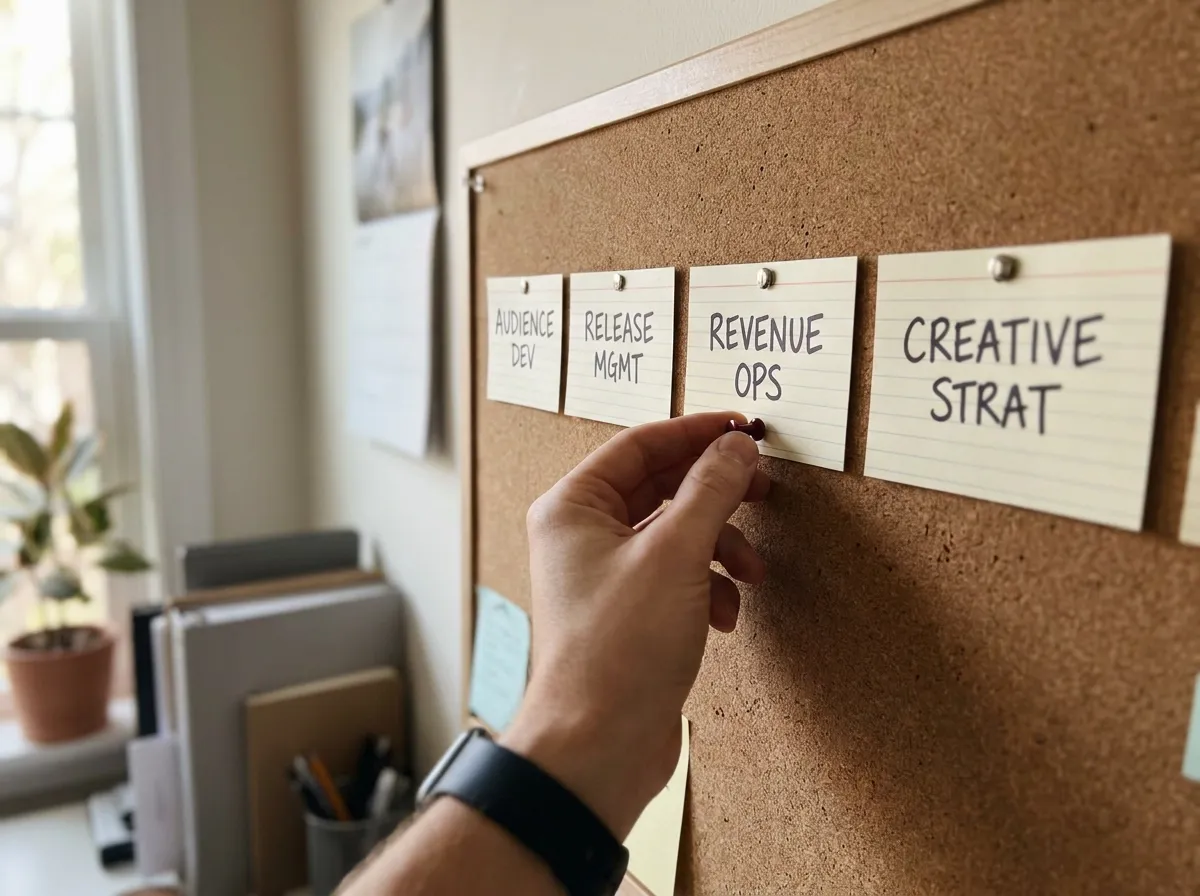
The four-job framework is ELM Tree Marketing's own argument, not a finding from the IFPI report, and the industry data above is market context, not proof that the framework works.
- Audience capture: converting a listener into a known, contactable person.
- Owned-channel growth: expanding reach on channels you control, not platforms that rent it to you.
- Monetizable offers: giving fans something to pay for beyond a stream.
- Repeat demand: a known fan consuming the next release without being re-acquired from scratch.
Repeat demand needs the clearest definition, because it is the job most artists never build. It is not loyalty as a feeling. It is a mechanism: a release cadence, catalog activity, live shows, a membership, or a seasonal offer that gives a known fan a scheduled reason to return.
One diagnostic before going further: which of the four jobs has no owner, no metric, and no budget line on your team? That gap is usually the constraint.
Job one: audience capture
Capture is the job the other three depend on. It has one test: can you reach this person directly, on a channel you control, without paying a platform for the privilege? A listener who streams, saves, and shares but leaves no contact detail is still anonymous.
Every capture point is a transaction where contact details change hands: email and SMS signups, pre-save flows, merch and ticket checkouts, direct-to-fan store purchases, gated downloads, QR codes at live shows, and community invites.
Platform followers are rented reach. You cannot message them, you cannot segment them, and an algorithm decides who sees you next. A large stream count with no captured contacts is a successful rental, not a marketing asset.
To make the job measurable, track how many contacts you capture relative to streams, net new contacts per release, cost per captured contact, and the share of contacts with a valid email or mobile number. Pull them monthly. The common mistake is counting followers, saves, or playlist adds as captured audience. Three tactics for the next release: a release-day exclusive reserved for email subscribers, checkout capture at the merch table, and a QR capture at shows.
Job two: owned-channel growth
Capture only creates value if the captured asset grows and stays deliverable. Owned channels are the infrastructure you control: email, SMS, your website, a direct-to-fan store, a fan community, and any membership layer. They survive algorithm changes, ad account restrictions, and platform policy shifts. Rented reach does not.
Growth is not list size. Track open and click rates against your own baseline, deliverability, replies and community activity, revenue per subscriber, and segmentation by geography, buyer type, and engagement. Deliverability is enforced by the inbox providers: Gmail's sender guidelines require bulk senders to authenticate their mail and to make it easy for recipients to unsubscribe.
Treat your website as the hub, not a business card. A release page, a tour and ticket page, a merch page, and consistent email capture turn search and social traffic into owned audience.
Then there is the dead-list problem. A large list that never gets mail is worth less than a small one with a regular reason to open. Send something useful between releases as well as at each release, and segment to protect engagement.
Job three: monetizable offers
Owned channels only pay off when they carry something to buy. A monetizable offer is anything a fan can pay for beyond a stream: vinyl and physical, merch, tickets and VIP, memberships, paid content, sync, brand partnerships, and presale access. A stream is a signal. An offer is revenue with a margin.
The demand exists. The same IFPI report states that physical formats returned to growth with revenues up 8.0 percent, including a 13.7 percent rise in vinyl, its 19th consecutive year of growth, per IFPI. Fans still pay for something tangible when the offer is built to be bought.
Ladder the offer rather than running one announcement. An entry item such as a limited variant or single merch drop, live at announcement. A middle tier that bundles physical with exclusive content, live at presale. A top tier of VIP, membership, or signed editions, offered to email and SMS first. A presale, a limited variant, and a bundle are three different jobs.
Before launch, confirm inventory, set fulfillment deadlines, test payment processing, and publish a clear return policy. Then measure attach rate, average order value, and revenue per captured fan rather than total units sold.
Job four: repeat demand

Offers convert captured fans once. Repeat demand makes them come back without you paying to re-acquire them.
Mechanisms that produce it include a predictable release cadence, catalog and anniversary activity, live shows, a membership or subscription, community rituals, and seasonal offers tied to dates fans already care about. Pick two or three and run them consistently rather than improvising around each drop.
Track return listener rate, repeat purchase rate, time between purchases, and the split between revenue from existing fans and revenue from new ones. If nearly all revenue arrives from newly acquired fans, you are renting an audience every cycle instead of building one.
One warning on data quality: if your numbers are inflated by bought streams or playlist schemes, you cannot read repeat demand from them, and you will make release decisions on false signals.
What changes before, during, and after a release
Before. Build capture infrastructure, finalize the offer, and warm owned channels so the release lands on people who already agreed to hear from you. Most of the four jobs are decided before release day.
During. Treat the traffic spike as a harvesting window. Push listeners into email, SMS, or your store, fulfill offers on time, and route attention toward something you control.
After. The months following a drop are where many artists go quiet. Run retention sends, catalog and live content, the next offer, and a review of which job produced the most value. This is where repeat demand is built or lost.
Where this fits
Find the one job on your team with no owner and no metric, assign it, and choose a single number to move through your next release cycle. One measured job beats four unmeasured intentions.
ELM Tree Marketing builds this as one connected system for artists and labels, with capture and owned channels handled through retention marketing. If you want an outside read on which of the four jobs is missing, start with a Growth Analysis.
FAQ
What is the difference between music promotion and music marketing?
Promotion is a concentrated burst of activity, such as social posts, playlist pitches, ads, and press outreach, packed into the weeks around a release date. Music marketing is a set of four standing jobs that run before, during, and after a release: audience capture, owned-channel growth, monetizable offers, and repeat demand. Promotion is a tactic; marketing is the operating system that keeps the audience after the spike.
What are the four jobs of music marketing?
The four jobs are audience capture (converting a listener into a known, contactable person), owned-channel growth (expanding reach on channels you control, such as email, SMS, and your website), monetizable offers (giving fans something to pay for beyond a stream), and repeat demand (a known fan consuming the next release without being re-acquired from scratch).
Why aren't streams and followers considered captured audience?
Platform followers are rented reach. You cannot message them, segment them, or control who sees your content, because an algorithm decides that. A large number of streams with no captured contact details is a successful rental rather than a marketing asset. Capture requires a contact detail, such as an email address or mobile number, that you can use directly.
How can artists measure whether their audience capture is working?
Track four metrics monthly: contacts captured relative to streams, net new contacts per release, cost per captured contact, and the share of contacts with a valid email or mobile number. Capture points include email and SMS signups, pre-save flows, merch and ticket checkouts, gated downloads, and QR codes at live shows.
What does repeat demand mean, and how can artists build it?
Repeat demand is a mechanism, not a feeling: a known fan's decision to consume your next release on their own. Artists build it through a predictable release cadence, catalog and anniversary activity, live shows and touring, memberships or subscriptions, community rituals, and seasonal offers tied to dates fans care about. Choose two or three of these and run them consistently. Track return listener rate, repeat purchase rate, and the split between revenue from existing and new fans.