
Local SEO for Fitness Studios: The Visibility Playbook That Fills Classes
- Doc. N°
- ELMTM-051
- Filed
- Class
- Local Search
- By
- Ethan Leard-Means
- Read
- 19 min
Most fitness studios are losing the local search battle before a single potential member ever sees their name. The problem isn't effort; it's the model. Generic local SEO services are built around stable demand and phone-call conversions, two assumptions that simply don't apply to a business where someone searches "yoga class near me" ten minutes before they want to show up.
Fitness studios operate on a fundamentally different discovery and booking cycle, and the SEO strategy has to match it. That means optimizing Google Business Profile categories for every discipline you teach, generating reviews at the pace that actually moves rankings, and building location pages that end in a trial booking rather than a contact form submission.
This guide covers exactly how to do that. You'll learn which GBP category choices expand your reach across multiple search queries, how class schedule schema markup gives you a technical edge almost no competitor has touched, and how to structure your entire local presence around the conversion path that matters: filling your intro-class pipeline with members worth $1,260 to $3,360 in lifetime value.
Why Generic Local SEO Advice Fails Fitness Studios
Most local SEO frameworks were built around a simple demand model: a potential customer has a problem, searches for a provider, and calls to book an appointment. That model fits a plumber, a dentist, or a law firm. It does not fit a fitness studio.
Fitness studios run on class schedules. A searcher looking for "yoga classes near me" at 5:45 pm isn't planning for next week; they're deciding whether to attend tonight. The optimization model has to match that urgency, which standard local SEO playbooks were never designed to do.
The conversion endpoint is different. Generic local SEO treats a phone call or contact form submission as the goal. For a fitness studio, those are dead ends. Success is a trial week booking or an intro class signup, completed online, in under three steps. Any optimization architecture that terminates at a click-to-call button is structurally misaligned with how fitness studios actually acquire members.
The geographic target zone is tighter than most owners realize. Members typically won't travel beyond a 10-15 minute commute from home or work. That means your ranking priority isn't a citywide footprint; it's a tight geo-cluster around your studio's address. Understanding why geography drives local search performance is foundational before any other optimization work begins.
Search timing compresses the revenue window. High-intent queries like "gym near me" or "pilates Houston" frequently occur within minutes of when someone intends to attend. Ranking position and booking-path friction aren't abstract SEO metrics at that point; they are direct variables in whether a seat gets filled.
The studios losing ground in the map pack aren't being outspent. They're applying a generic checklist: claim the Google Business Profile, collect a few reviews, build some citations. Those steps are table stakes. The fitness-specific optimizations layered on top of that foundation are where map pack visibility is actually won or lost, and most studios haven't touched them yet.
GBP Category Selection: The Highest-Impact Setting Most Studios Get Wrong
Category selection is where most studios silently hemorrhage map pack visibility, and fixing it costs nothing but attention.
95% of fitness businesses use only one GBP category. That single setting limits their search surface to whatever that one category matches, while every other discipline they offer goes unrepresented in the algorithm. A studio running yoga, barre, and strength training under one roof but listed only as "Fitness Center" is effectively invisible to anyone searching "barre classes near me" or "yoga studio Houston."
The reason discipline-specific categories outperform the generic option is straightforward: they match the actual search intent. When someone types "pilates classes near me," Google's ranking logic prioritizes profiles categorized as "Pilates Studio" over profiles categorized as "Fitness Center," because the former directly signals relevance to that query. "Yoga Studio," "Boxing Gym," "Cycling Studio," and similar discipline-specific options each open a separate relevance channel that "Gym" or "Fitness Center" simply cannot replicate.
How to Stack Categories for a Multi-Discipline Studio
The fix follows a clear sequence:
Audit Google's fitness category library. There are many relevant options across disciplines. Open your GBP profile, go to Edit Profile, and search each discipline you offer to confirm a matching category exists.
Assign your primary category to your anchor discipline. Use your highest-revenue or highest-search-volume modality here. This is the category that carries the most ranking weight.
Fill secondary category slots with every remaining modality. Most hybrid studios leave three to five secondary slots empty. Each empty slot is a discipline that can't rank.
Match categories to active classes only. Don't claim "Cycling Studio" if you discontinued spin classes. Mismatched categories confuse the algorithm and erode relevance signals.
A studio running CrossFit, yoga, and barre that completes this audit typically finds it was competing on one category while its members were searching across three. Correcting that structure expands the studio's search footprint immediately, without a single new review or backlink. Understanding which business types qualify for related local advertising products is also worth reviewing once your GBP foundation is solid.
Review Velocity Over Volume: How to Build a Review Engine Around Member Milestones
Once your GBP categories are locked in, the next signal that separates map pack leaders from mid-pack studios is review velocity, not total star count.
Recency outweighs volume. A studio with 40 reviews accumulated over six months will typically outrank one sitting on 200 reviews that are 18 to 24 months old. Google's local algorithm treats fresh reviews as an active prominence signal. A stale review profile, no matter how large, reads as an inactive business.
The timing of your request determines your conversion rate. A best-practice trigger is an SMS sent within 30 minutes of class completion, while the experience is still immediate. A weekly newsletter ask arrives days later, after the moment has passed and the emotional motivation is gone. Those two channels are not interchangeable.
A proven-in-practice milestone cadence looks like this:
Post-class (within 30 min): First review request, tied to the specific class attended
Day 30: A check-in message that celebrates the member's first month and includes a second review invite
Day 90: A progress-reinforcing touchpoint that repeats the ask, framed around the member's results
This structure keeps fresh reviews flowing across the full onboarding journey rather than clustering them in week one.
Responding to reviews is not optional courtesy. Studios that reply to every review, positive and negative, signal active profile management and reinforce the engagement pattern Google rewards in prominent profiles. Ignoring reviews, or batching responses monthly, undercuts the signal your volume is trying to build.
Automate the system so it runs without manual effort. Platforms like Mindbody, Mariana Tek, and Glofox are commonly used to build automated messaging workflows tied to class attendance milestones rather than arbitrary calendar intervals. Map requests to behavior, not to dates. For a broader look at what automated sequences every gym should run, the architecture extends well beyond reviews into retention and reactivation.

Class Schedule Schema Markup: The Technical Edge Almost No Competitor Has Implemented
Review velocity addresses how often your profile earns trust signals. Schema markup determines whether Google can actually read what you're selling once searchers arrive.
Most fitness studio websites implement no structured data or a generic LocalBusiness or HealthClub schema. Both tell Google what the business is. Neither communicates what's happening at 6 a.m. on Wednesday. Event schema, the structured data format Google officially supports for physical events, closes that gap by making specific class details machine-readable and eligible for rich result features inside search results.
What Event schema enables that generic schema cannot:
Class name and type surfaced in rich results carousels
Instructor name tied to the specific session
Start time and recurrence pattern visible without a click-through
Direct booking URL attached to the event entry
Google requires a physical location for Event schema to qualify for rich results. In-person fitness classes satisfy that requirement cleanly; virtual-only offerings do not.
Implementation Priority Order
Step 1. Add Event schema to each class type's landing page or schedule page. Required fields include name, startDate in ISO 8601 format with timezone, and a physical location. High-value optional fields: instructor as performer, booking URL as offers.url, and recurrence pattern. Cover each class type as its own schema block, not the studio generically.
Step 2. Publish a llms.txt file at your domain root. This plain-text file describes your class offerings, instructor roster, and booking flow in a format AI search engines can parse directly. As AI Overviews expand into booking-intent queries, this file positions your schedule data for citation inside those results, an opportunity most competitors have not addressed.
Step 3. Validate every implementation using Google's Rich Results Test before publishing, then monitor Search Console for class-time rich result appearances.
For broader engagement strategy tied to these technical foundations, the Key Takeaways from ELM Tree's fitness email marketing guide offer relevant cross-channel context.
Schema is structured communication with the search systems that decide what to surface when someone searches for a 7 a.m. class near them. Studios that implement it now establish a visibility position that late adopters will find increasingly costly to replicate.
GBP Prominence Signals: Photo Cadence, Profile Completeness, and What Actually Moves Rankings
Schema markup gets your classes into search results. What keeps your entire profile ranking above competitors comes down to a different layer entirely: GBP prominence.
Prominence is a composite signal. Google evaluates review volume, review recency, citation consistency, profile completeness, and ongoing engagement activity together, not in isolation. Studios that complete their GBP setup once and walk away are effectively competing at a structural disadvantage against profiles that are actively maintained.
Photo cadence is one of the most underused levers. Posting 5 to 10 images per week drives measurably higher engagement scores inside GBP. Prioritize classes actively in session over empty studio shots, instructor headshots paired with names, and equipment that visually signals your disciplines. An active photo stream signals that the business is current and worth surfacing -- Google's own guidance confirms that photos and videos help show what you offer.
Profile completeness extends well beyond hours and phone number. Three areas most studios leave incomplete:
Services section: List every class type with a short descriptor, not just a category name
Q&A section: Seed it yourself with the questions new members actually ask (parking, trial class policy, skill level requirements), then answer them
GBP posts: Use them as a lightweight content channel for new class announcements, instructor spotlights, and schedule changes; weekly cadence is sufficient
Treating your Google Business Profile as a primary acquisition channel, rather than a static directory listing, is the operational shift that separates studios ranking consistently from those that plateau.
Citation consistency is a silent ranking suppressor that hits studios hardest after a location move or a name change. Your name, address, and phone number must match exactly across Yelp, Mindbody marketplace, ClassPass, Facebook, and Apple Maps -- any variation can undermine the consistency signals local algorithms reward.
For studios in competitive metro markets, a citation audit run by a local SEO expert or local SEO agency often surfaces the specific inconsistencies holding a well-reviewed profile out of the top map pack positions.
Location Pages That Convert Searchers Into Trial Bookings
Ranking is only half the job. A location page that pulls strong map pack traffic but routes visitors to a generic homepage contact form has a broken revenue path, and for fitness studios, that break is measurable in empty class spots.
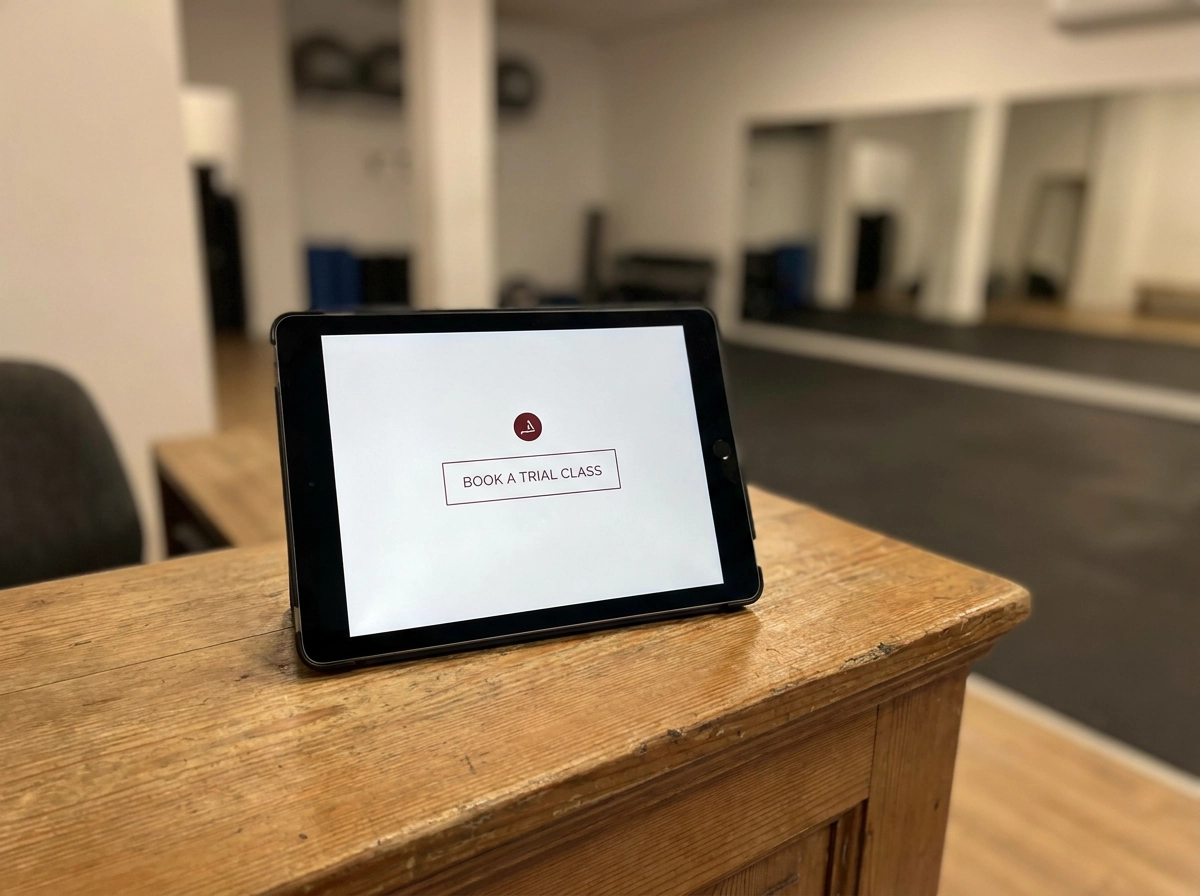
Conversion on a fitness location page means one action: a trial week signup or intro class booking. Not a phone call. Not a contact form. Any CTA that doesn't end at a booking confirmation is misaligned with how fitness studio revenue actually works.
The Structure That Converts
High-performing fitness location pages follow a specific architecture:
Geo-qualified headline targeting the neighborhood or district, not just the city ("Pilates Classes in Montrose" outperforms "Pilates Classes in Houston")
Class type signals above the fold for every discipline offered at that location
Live or embedded schedule showing today's available classes
Single prominent CTA linked directly to the trial booking flow
Location-specific social proof pulled from GBP reviews, not generic testimonials
Booking Flow Is an SEO Signal
Integrating a frictionless booking flow (Mindbody, Mariana Tek) with fewer than three steps to confirmation does more than improve conversion. Lower bounce rates and longer engagement times from a smooth handoff feed back into GBP and organic ranking signals. Routing visitors through a generic homepage before they can book adds friction and costs you on both fronts. For more on structuring a conversion path that closes without pressure, Step 4: Build a Conversion Path That Closes Without a Hard Sell covers the full framework.
Multi-Location Pages Require Unique Content
Each location needs its own page with location-specific copy, an embedded map, reviews from that facility's members, and the schedule for that specific timetable. Duplicate pages with only the address swapped are a common technical SEO error that suppresses ranking across all locations simultaneously.
The Revenue Math
At $140 per month across a 9-to-24-month retention window, each member acquired through organic search represents $1,260 to $3,360 in lifetime value. The difference between a high-performing and an under-optimised location page from the same traffic volume is not marginal -- it's the difference between a page that funds itself and one that quietly underperforms.
Why Map Pack Dominance Beats Content Marketing for Most Fitness Studios
With location pages handling the conversion layer, the question becomes: what drives searchers to those pages in the first place? For most fitness studios, the answer is the map pack, not blog content. Yet a significant share of studio competitors are pouring resources into posts about "benefits of yoga," "how to start strength training," and "best exercises for beginners" while leaving their GBP signals largely unoptimized. That misallocation is exploitable.
Map pack positions respond to GBP optimisation signals -- not content word count -- and that's where searcher intent converts.
This isn't an argument against content entirely. Class-type landing pages, instructor bios with schema markup, and neighborhood-targeted location pages all support organic visibility for intent-matched queries. The distinction matters: those are conversion-oriented content assets built around specific search intent. Generic fitness blog content attracts informational traffic from people researching exercise habits, and that audience almost never converts into trial memberships.
Studios evaluating fitness SEO services or local SEO services should push for a sequenced model: GBP optimization and profile completeness first, review generation system second, location page architecture third. The connection between GBP, local SEO, and design decisions that reinforce regional market visibility is worth understanding before any content investment begins, because map pack visibility delivers measurable trial booking impact on a faster timeline than organic blog traffic.
The competitive window here remains open. Boutique studios with properly structured GBPs routinely outrank larger gym chains on discipline-specific and neighborhood-level queries. Proximity and relevance signals favor the local specialist; a precisely categorized, actively managed GBP beats a chain's broader profile on the queries that matter most.
Instructor Social Presence as a Secondary Discovery Channel
Map pack visibility addresses discovery at the search level. Instructor social presence operates one layer upstream, capturing potential members before they ever type a query.
Boutique fitness members frequently follow a specific instructor rather than a brand. That loyalty pattern creates a parallel discovery path: a prospective member searches a trainer's name, finds their Instagram, and follows the bio link to the studio's booking page. Studios that haven't structured this path lose those searchers to friction rather than competition.
What Each Instructor Account Should Do
The implementation requires three consistent behaviors from every instructor with a public account:
Tag the studio account in every class-related post
Link directly to the studio's trial booking page in their bio, not the studio homepage
Apply a location tag to every post, connecting the content to geographic search layers across Instagram and cross-platform discovery
These three steps create a branded search layer that surfaces both the instructor and the studio across social and AI-assisted search queries, without requiring any paid media.
Website Profiles as an SEO Asset
Instructor profiles on the studio website should go beyond a headshot and a short bio. Each profile should include the instructor's class schedule, areas of specialty, and a structured internal linking pattern that strengthens topical relevance for discipline-specific queries. If you're thinking through how to integrate local SEO directly into your content strategy, instructor profile pages are an underused starting point.
Treating High-Follow Instructors as Distribution Assets
Instructors with a meaningfully engaged following represent a genuine distribution channel. Studios should treat those accounts accordingly: coordinate class announcements, schedule changes, and new offerings across instructor channels as standard operating procedure, the same way they'd use an email list or GBP post cadence.
When an instructor builds a personal audience that consistently points back to the studio, the studio gains compounding word-of-mouth reach that no ad budget can replicate cleanly.
AI Search Readiness: Structuring Your Studio for How People Search in 2026
Instructor social presence creates a discovery layer that points searchers toward your studio. What happens when they search and an AI answers before they ever reach your site?
Google AI Overviews now trigger on roughly 48% of tracked search queries, a figure that grew 58% year-over-year through early 2025. Chat-based search interfaces are accelerating the same behavior. Both systems pull structured data directly from business websites to answer availability and booking queries in the results, bypassing the click-through entirely. For fitness studios, this means a searcher asking "yoga classes near me tonight" may never visit your site at all unless your data is structured for machines to read and cite.
Step 1: Publish a llms.txt file at your domain root. This plain-text file describes your class offerings, instructor roster, location, and booking flow in clean, machine-readable format. It functions as a direct brief to AI crawlers. Very few fitness studios have deployed one, making it among the lowest-effort, highest-differentiation technical moves available right now.
Step 2: Apply Event schema to every class page if you haven't already -- the same implementation serves both traditional rich results and AI search entity parsing.
Step 3: Integrate your booking link inside both your GBP and your schema markup. When an AI overview surfaces a class recommendation, the booking path needs to be one tap away. A searcher who has to navigate independently after an AI answer often does not complete the booking. Friction at that handoff converts interest into abandonment.
Studios evaluating fitness SEO services or local SEO services should ask direct questions: does the scope include llms.txt deployment, Event schema implementation, and booking link integration into structured data? An agency optimizing exclusively for 2022-era ranking signals is building toward a widening relevance gap, not closing it.

How a Fitness-Specific Local SEO System Comes Together
Each optimization covered in this guide pulls more weight when connected to the others. Category architecture determines which searches find you. Review velocity determines whether you rank within those searches. Schema markup determines whether your class schedule appears in the result. Location pages determine whether the visitor books. No single layer closes the acquisition loop on its own.
Most studios that engage local SEO services or hire a local SEO agency receive a generic execution checklist built for any business type. A fitness-specific model runs in a deliberate sequence: GBP category architecture and profile completeness first, then review generation tied to class attendance and member milestones, then schema and booking flow optimization, with location pages built as conversion infrastructure rather than informational placeholders.
The timeline this model produces is faster than most studio owners expect. In competitive metro markets, properly executed GBP optimization typically delivers first intro-class signups from organic search within 30 to 60 days, not after months of content publishing. That speed reflects how directly the map pack responds to prominence signals when the foundational work is complete and correctly structured.
This is the distinction between treating local SEO as a checklist and operating it as a member acquisition system. The math on lifetime value justifies building it correctly.
ELM Tree Marketing builds this system for fitness studios as part of a structured revenue approach that connects local SEO, Google Business Profile optimization, location page design, and booking flow conversion into a single architecture. The work is not sold as an isolated SEO service; it is structured around the business outcome: a full intro-class pipeline.
For studios ready to make that shift, the right starting point is a GBP and location audit that surfaces exactly where visibility gaps and conversion gaps exist before any implementation begins.
Conclusion: Your Local SEO Playbook Starts with the Right Model
The system this guide describes only works when every component is installed. Here is your execution sequence.
Audit your GBP categories first. Audit your GBP categories: primary category should name your actual discipline, every secondary slot should reflect a modality you actively offer.
Build a review generation workflow tied to behavior, not calendar. Build a review generation workflow tied to behavior, not calendar -- three milestone triggers (post-class, 30-day, 90-day) sustain recency signals through the full onboarding journey.
Deploy Event schema and a llms.txt file. Deploy Event schema on each class schedule page and publish a llms.txt file at your domain root -- both position your studio for AI search visibility most competitors have not addressed.
Audit every location page against the conversion framework. Each page needs a geo-qualified headline, above-the-fold class type signals, an embedded live schedule, a single trial booking CTA, and location-specific reviews. If your current pages do not match that structure, they are ranking without converting.
Hold the blog content budget until your map pack foundation is solid. GBP completeness, review cadence, citation consistency, and location page architecture determine whether fitness searchers find you. Organic blog traffic rarely converts into trial memberships at a rate that justifies prioritizing it ahead of the signals that actually move map pack position.
Each of these actions is discrete, sequenceable, and measurable. Work through them in order and your studio stops competing on a generic checklist and starts operating a system built for how fitness discovery actually works.
FAQ
Why doesn't generic local SEO work for fitness studios?
Generic local SEO strategies are built around the assumption that potential customers search for a service, find a provider, and call to book an appointment. Fitness studios operate on a different model. Members search for classes at the last minute (often within minutes of when they want to attend), and they expect to book online in three steps or fewer. Generic SEO frameworks terminate at a phone call or contact form, which are dead ends for fitness studios. The goal must be a trial booking or intro class signup, completed online, and the geographic targeting must focus on a tight 10-15 minute radius around your studio rather than citywide visibility.
How many Google Business Profile categories should a multi-discipline studio have?
Most studios use only one GBP category, which limits their search visibility to that single discipline. The best practice is to assign your primary category to your highest-revenue or highest-search-volume discipline, then fill secondary category slots with every remaining modality you actively offer. A studio running CrossFit, yoga, and barre, for example, was likely competing on just one category when its members were searching across three. By filling secondary slots with discipline-specific categories like 'Yoga Studio,' 'Boxing Gym,' and 'Cycling Studio,' you open separate relevance channels that generic categories like 'Gym' or 'Fitness Center' cannot replicate.
What is more important for local rankings: the total number of reviews or review recency?
Review recency significantly outweighs total volume. A studio with 40 fresh reviews accumulated over six months will typically outrank one with 200 reviews that are 18-24 months old. Google's local algorithm treats recent reviews as an active prominence signal, while a stale review profile—no matter how large—reads as an inactive business. The best practice is to request reviews at strategic milestones: within 30 minutes of class completion via SMS (while the experience is fresh), at the 30-day mark celebrating their first month, and again at the 90-day mark reinforcing their progress. This approach keeps fresh reviews flowing throughout the member onboarding journey rather than clustering them in week one.
What is Event schema markup and why does it matter for fitness studios?
Event schema is structured data that makes your class details machine-readable to search engines and AI systems. While most fitness studios use generic LocalBusiness or HealthClub schema (which only tell Google what the business is), Event schema communicates what's actually happening at specific times—like 'yoga class at 6 a.m. on Wednesday.' Event schema enables class names, instructor information, start times, recurrence patterns, and direct booking URLs to appear in rich result carousels and AI Overviews without requiring a click-through. As AI Overviews expand into booking-intent queries, implementing Event schema positions your classes for citation inside those results, giving you an edge over competitors who haven't addressed this opportunity.
How quickly can properly optimized local SEO deliver results for a fitness studio?
In competitive metro markets, properly executed GBP optimization typically delivers first intro-class signups from organic search within 30 to 60 days, not after months of content publishing. This speed reflects how directly the map pack responds to prominence signals when the foundational work is complete and correctly structured. The key is following the sequenced model: optimize your GBP category architecture and profile completeness first, then implement a review generation workflow tied to member milestones, then deploy Event schema and AI-readiness features, then ensure your location pages are built for conversion. Each member acquired through organic search represents $1,260 to $3,360 in lifetime value (at $140 per month with a 9-24 month retention window), so getting the system right delivers measurable financial impact.