
Google Local Service Ads vs. Your Google Business Profile: Where a Local Budget Goes Further
- Doc. N°
- ELMTM-066
- Filed
- Class
- Local Search
- By
- ELM Tree Marketing
- Read
- 11 min
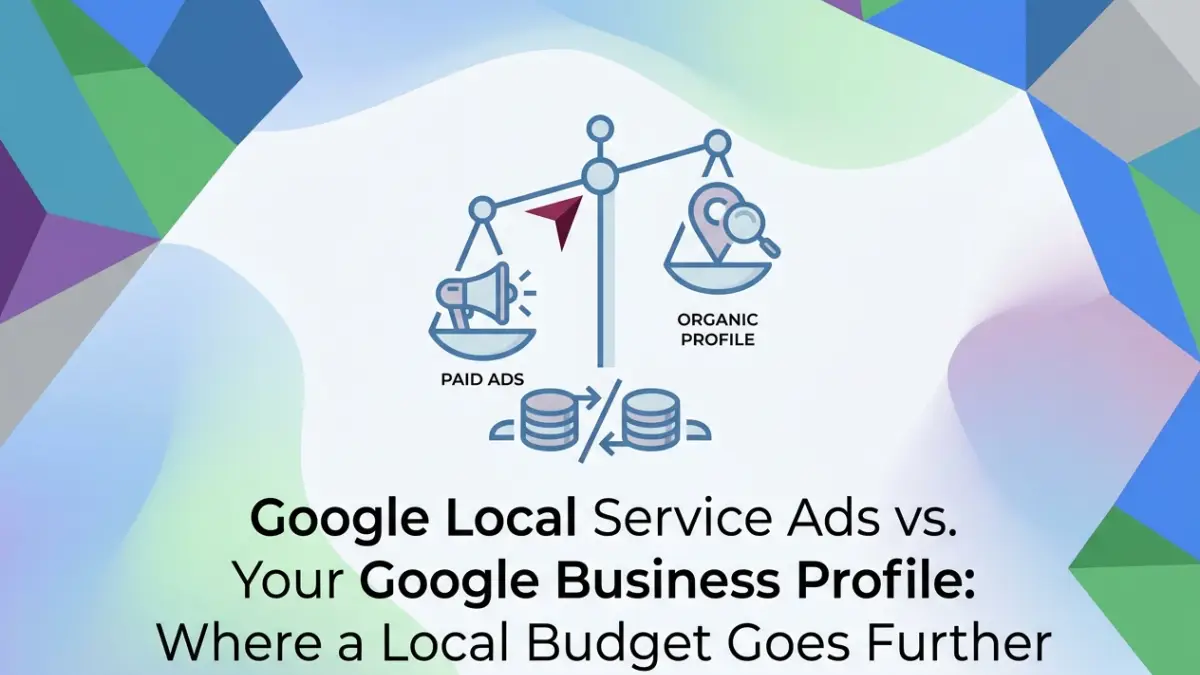
Every local budget makes a promise: it either buys attention today or builds an asset that keeps working. For brick-and-mortar brands, the choice between Google Local Service Ads and a Google Business Profile is not as simple as picking the cheaper channel. Google Local Service Ads let you pay for verified leads when demand is already searching. Your profile and the local content around it earn visibility on Search and Maps without a per-lead fee, and that visibility compounds as reviews, posts, photos, and citations accumulate.
Most brands should not choose one forever. The smarter play is a staged mix. You rent demand through Google Local Service Ads where you cannot rank yet, then use profile and local content work to reduce how much paid coverage you need. This comparison will walk through how LSAs and your profile solve different problems, how LSAs work on a pay-per-lead, twice-verified model, what your Google Business Profile buys you, the head-to-head tradeoff between renting demand and compounding visibility, budget allocation, eligibility and compliance, measuring whether local SEO is reducing paid dependence, and a scenario-based next step. By the end, you will know how to allocate a local budget.
LSAs and Your Profile Solve Two Different Problems
Google Local Service Ads (LSAs) rent attention. Your Google Business Profile (GBP) is an owned asset. That distinction drives every dollar you allocate.
Two spend models, one line each:
Paid per lead: You buy a verifiable phone call, message, or booking from a high-intent searcher today.
Owned visibility: Profile and local content work compound in Search and Maps over quarters, increasing how often you appear without a click cost.
This is not either/or. For most brick-and-mortar brands the right answer is a staged mix: LSAs cover demand you cannot rank for yet, while profile and local content work shrinks how much of that demand you keep renting.
On sourcing: LSA pricing, verification, and eligibility claims are attributed to Google's own LSA help documentation. Claims that owned local assets reduce paid dependence are labeled as agency experience unless independent evidence is cited. Google is a commercially interested source on its own paid product, so read its performance language as positioning.
Run this self-check now:
Do you already rank in the local pack for your money terms?
Do you have open capacity to serve more customers?
Ranking plus open capacity often means you are paying for leads you could earn. Across multiple locations, that signal gets harder to hold, which is where multi-location profile management becomes its own discipline.
This is a spend-allocation decision, not a definitions lesson. You will leave with a model, not a verdict.
How Google Local Service Ads Actually Work: Pay Per Lead, Verified Twice
Google's LSA help documentation says advertisers pay per lead, not per click: you are charged when a searcher contacts you, not when the ad is shown or tapped. Invalid or low-quality leads are not charged, charged leads are reassessed over time, and credits usually post to your balance within 30 days, though the original charge stays on the invoice.
The Lead Flow
The ad runs in a distinct unit above standard results with Call and Message buttons, and interactions are reviewable in the Local Services dashboard. Recording and transcript availability varies; confirm it in Google's documentation.
Verification, Placement, and Gating
Google Guaranteed involves background screening plus license and insurance verification. Current lead handling centers on automatic reassessment and "Rate this lead" feedback; published terms do not state a fixed dispute window, so verify the process rather than assuming one.
Reported inputs include responsiveness, proximity, review count, hours, and budget settings, though Google does not publish a definitive list. Responsiveness is the lever most brands underuse, and the fastest fix.
LSA availability is limited to categories and geographies set by Google policy; the help page excludes lead credits for health care verticals and tax specialists. Verify eligibility for your exact category and state. Google does not publicly document whether your Business Profile affects LSA eligibility or placement.
What Your Google Business Profile Really Buys You

If Google Local Service Ads rent attention lead by lead, your Google Business Profile is the asset you own. It is Google's unpaid listing product for Search and Maps, and the fields that drive visibility are primary and secondary categories, services, service areas, hours, attributes, photos, and a compliant business description. Google states there is no way to pay for better local ranking.
Local pack position runs on relevance, distance, and prominence. You cannot move closer to the searcher, and relevance is largely category fit. Prominence is the improvable lever, built through reviews, citations, links, and content, which is why profile work compounds rather than finishing.
Ranking is not the same as earning. The converting features are review responses, seeded Q&A, Google Posts, and live messaging or booking paths. A profile that ranks but does not convert is renting nothing and earning nothing.
Local content amplifies it. Dedicated service and city pages, structured internal linking, consistent NAP across citations, and location-specific landing pages give the profile more relevant surface to rank against. A managed local SEO service typically layers citation cleanup, review generation systems, and location page architecture on top of profile optimization, work that reduces paid dependence over time.
One caveat: Google does not document any relationship between profile status and LSA eligibility. Do not assume optimizing your profile unlocks paid ad placement. The profile is front-line infrastructure, not an ad key.
Head to Head: Renting Demand vs. Compounding Local Visibility
How you rank organically and how you buy leads are two balance sheets:
Dimension | Local Service Ads | Profile and local content |
|---|---|---|
Time to first result | Leads within days of approval | Local pack movement in months |
Cost structure | Pay per qualified lead; priced by trade, market, competition | Profile is free; real cost is labor and content |
Scalability ceiling | Cost per lead flat or climbing with competition | Marginal cost of an already-ranking asset approaches zero until capacity caps it |
Control over messaging | Leads arrive as calls and messages; policy limits creative | You own the landing asset; route traffic to booking, signup, or store visit |
Compliance exposure | Category eligibility, screening, platform rule and pricing changes | Execution risk; a neglected profile can be outranked by a stronger review signal |
When you stop paying | Leads and visibility stop | Rankings decay slowly |
Read across rows. LSA leads must be handled fast to protect ranking, and paid cost per lead stays flat or climbs with competition; the marginal cost of an already-ranking asset approaches zero until capacity caps it. Profile traffic lands on assets you design, so which listings and directories you claim first shapes how much surface you can defend. Both sides carry risk: LSAs through eligibility and platform change, owned assets through neglect. The allocation model later returns to this table.
LSAs buy demand you have not earned yet, and profile work lowers the price of demand you will need every month.
The Staged Mix: How to Allocate a Local Budget
Treat this as an operating framework, not benchmark data. Three stages: coverage, substitution, defense. The trigger from one stage to the next is measurable ranking and lead-cost movement, not a calendar date.
Stage one, coverage. Weight spend toward LSAs when you are invisible for your money terms or newly opened. Paid leads create cash flow while profile and local content work gets established. Set a quarterly review cadence so coverage does not become permanent.

Stage two, substitution. As the profile ranks for specific service and location terms, move those terms out of paid coverage and into organic tracking. Reallocate freed spend toward profile content, reviews, and location pages.
Stage three, defense. With core terms stable, keep a smaller LSA budget for geographic pockets and services you cannot rank for. Protect the ranking with review velocity and content refresh.
A modeling example, not a guarantee: 70 percent paid, 30 percent owned at launch, moving toward 30/70 by month twelve for a brand with steady capacity. Seasonal and capacity overlay: raise paid coverage during peak demand and pause it when appointments, class slots, or stock are constrained. Paying for leads you cannot serve is the most common waste here.
Shift signals: lead cost rising, organic local pack impressions climbing, or booked leads from the profile versus ads crossing a threshold you set in advance. Market-specific rules can change which levers are even available, so check the rules in each market before locking the split.
Eligibility and Compliance Before You Spend a Dollar
Before you allocate a dollar to either channel, confirm the paid option is even open to you. Local Services Ads are gated by category and location, not by how legitimate your business is. A fully licensed shop can be blocked by platform policy. Verify eligibility against Google's current LSA policy for your exact category and state before promising a client anything.

This matters most for smoke, hemp, and adult beverage brands, where federal rules, state licensing, and platform policy often point in different directions. Google's recreational drug policy prohibits ads for products marketed to facilitate recreational use, such as pipes, while hemp and CBD rules have shifted in parts of the U.S. Age-gating, labeling, and advertising rules can also vary by state regulator.
If your category is gated, a profile-first strategy is not a consolation prize. It is the only durable channel: strong local SEO, a review system, and location content that compounds. That is why the compounding argument matters more for restricted verticals, not less.
Lead-based advertising carries its own compliance load. Document disputed leads, keep records that support verification, and meet consumer-protection expectations for how leads are contacted and disclosed.
Finally, treat the eligibility check as recurring. State advertising and age-gated product rules move faster than platform policy, so what was accurate at onboarding may be wrong a year later.
Measuring Whether Local SEO Is Reducing Your Paid Dependence
Eligibility settled, the next question is whether the money is working. Owned share of leads answers it: profile and local organic leads divided by total local leads, trended over rolling quarters rather than month to month, because monthly swings mislead.
The paid side needs four numbers: cost per valid lead after disputes, lead-to-booking rate, response time to first contact, and the share of leads arriving outside your service area or hours. The owned side tracks profile impressions and calls, direction requests, website clicks from the profile, local pack position for a fixed set of money terms, and review velocity.
Read them together. When organic local pack impressions rise for terms you previously only bought, and LSA cost per booked customer holds or falls, the staged mix is working. If paid cost climbs while organic stays flat, owned assets are underinvested.
Attribution can stay lightweight. Track call source in the profile dashboard, use a separate booking link for organic versus paid, and ask one source question at intake.
The common mistake is comparing total LSA spend to total local SEO spend without normalizing for lead quality, close rate, and customer lifetime value. That comparison flatters whichever channel has the shorter reporting loop. Normalize first, then compare.
What to Do Next: A Scenario-Based Recommendation
With your baseline set, allocation becomes mechanical. Three starting points cover most brick-and-mortar brands.
New or invisible location: Start roughly 70 percent paid, 30 percent owned. Watch cost per valid lead. When profile impressions and local pack rankings climb for your money terms, move those terms to organic tracking and shift the freed spend.
Established location already in the local pack: Weight the mix toward owned, keeping paid only for gaps. Watch owned share of leads. If paid cost rises while rankings hold, cut paid budget further.
Restricted-category brand: Verify LSA eligibility against current Google policy before allocating anything, since category gating can block participation entirely. If ineligible, run a profile-first strategy and track local pack position and review velocity as your growth metrics.
Across all three: confirm eligibility, use LSAs for demand you cannot rank for, build profile and local content in parallel, then move budget out of paid as owned terms rank.
ELM Tree Marketing (ELMTM) runs profile, local content, and customer acquisition as one system, including for 21+ brands where paid eligibility is limited.
Review your paid-to-owned lead ratio quarterly and apply the same triggers each time, not reacting to one expensive month.
Conclusion
LSAs and your Google Business Profile solve different problems. LSAs buy qualified demand now, while your profile compounds local visibility over time. The smartest budget is not either/or; it is a staged mix. Start with eligibility, set a baseline, and shift spend from paid to owned as your money terms rank. Review your paid-to-owned lead ratio quarterly, not after one costly month.
That discipline turns local marketing from a guessing game into a system. You rent leads when needed, build durable assets in parallel, and reduce paid dependence as your presence strengthens. Ready to put your budget where it works harder? Check your LSA eligibility and map your 70/30 or profile-first plan. If you want your paid-to-owned ratio measured rather than estimated, apply for a Growth Analysis with ELMTM.
FAQ
What is the difference between Google Local Service Ads and a Google Business Profile?
Google Local Service Ads (LSAs) rent attention: you pay per verified lead when a searcher contacts you, and the spend stops when you stop paying. A Google Business Profile (GBP) is an owned, unpaid listing for Search and Maps. Its visibility compounds over time through reviews, posts, photos, citations, and local content, without a per-lead fee.
How do Google Local Service Ads charge for leads?
According to Google's LSA help documentation, advertisers pay per lead rather than per click or impression. You are charged when a searcher contacts you by call, message, or booking. Invalid or low-quality leads are not charged, and charged leads can be reassessed over time. Credits usually post to your balance within 30 days, though the original charge remains on the invoice.
Should I use Local Service Ads or focus on my Google Business Profile?
For most brick-and-mortar brands, the best approach is a staged mix rather than choosing one permanently. Use LSAs to cover demand you cannot yet rank for, and invest in profile and local content work to gradually reduce how much paid coverage you need. A common starting point is about 70 percent paid and 30 percent owned, shifting toward owned as your money terms rank. This is a modeling example, not a guaranteed benchmark.
Can optimizing my Google Business Profile get me into Local Service Ads?
Not according to the available sources. Whether a Google Business Profile affects LSA eligibility or placement is not confirmed, so you should not assume that optimizing your profile unlocks paid ad placement. LSA eligibility is gated by category and location under Google policy, so verify your exact category and state against Google's current LSA policy before allocating budget.
How do I know if local SEO is reducing my paid advertising dependence?
Track owned share of leads, which is profile and local organic leads divided by total local leads, and review the trend over rolling quarters rather than month to month. If organic local pack impressions rise for terms you previously only bought, and LSA cost per booked customer holds or falls, the staged mix is working. If paid cost climbs while organic stays flat, your owned assets may be underinvested. Compare channels using normalized metrics such as lead quality, close rate, and customer lifetime value, not raw spend totals.