
Why Wellness Brands Stall After Their First Growth Spike and How to Fix It
- Doc. N°
- ELMTM-039
- Filed
- Class
- Health & Wellness
- By
- Ethan Leard-Means
- Read
- 19 min
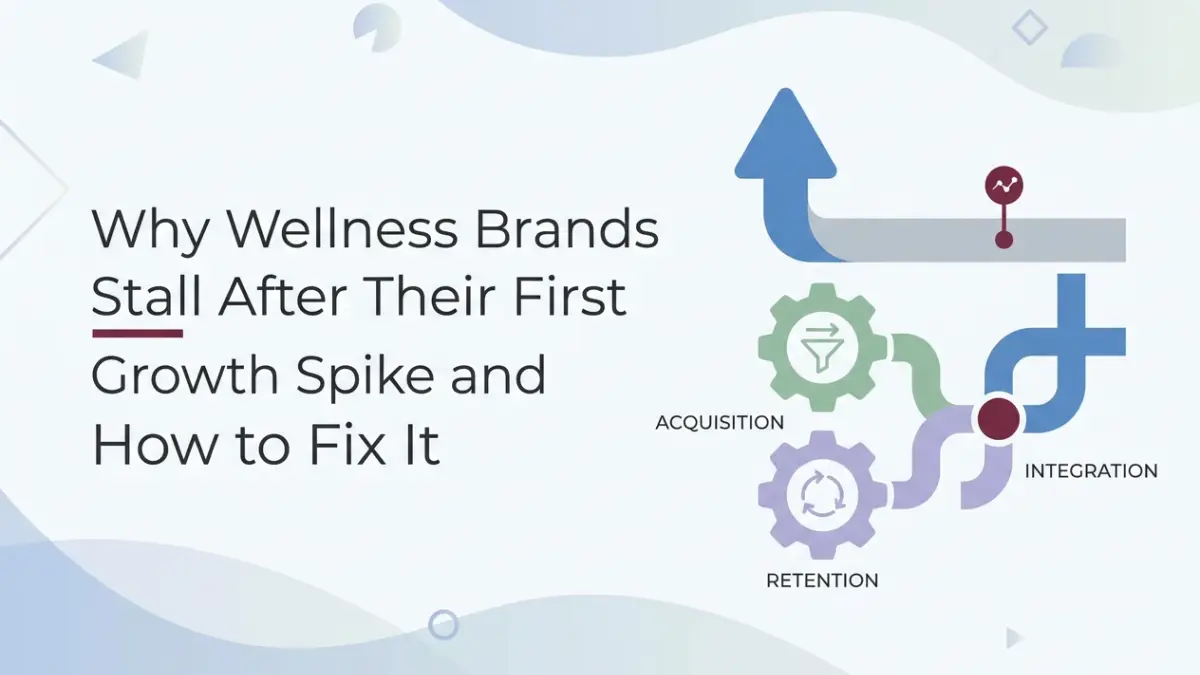
Most wellness brands do not stall because their product stops working or their ads lose their edge. They stall because the structure holding their growth together was never built in the first place. The initial spike looks like proof of concept. In reality, it exposes every gap that a burst of momentum can temporarily hide.
This is a brand marketing problem at its core, but not the kind that gets solved with a new creative brief or a bigger media budget. The plateau that follows a strong launch is structural. It lives in the broken handoffs between acquisition, conversion, and retention systems that were built independently and never connected into something that compounds.
In this post, we diagnose exactly where those breaks occur and why they are so common in growing wellness businesses. You will learn why the spike rarely repeats on demand, which three structural failures are responsible for most plateaus, and how to sequence the fixes so each one reinforces the next. If your growth has flatlined after a promising start, this analysis will tell you why, and show you the path forward.
Why the Spike Happens and Why It Never Repeats on Demand
The first growth spike feels like proof. A campaign lands, a creator post goes wide, a PR mention drives search volume, and suddenly the revenue chart looks exactly like what you imagined when you launched. Then it stops. Not gradually, it just stops compounding, and the same tactics that worked three months ago produce diminishing returns every time you try to replay them.
That pattern is not a mystery. It is a mechanical outcome of what a launch spike actually is.
A launch spike is produced by three conditions converging simultaneously: concentrated spend hitting a fresh audience, the novelty premium that any new brand earns before the market has fully categorized it, and an earned media surface area that exists because a launch is a real event worth covering. None of those conditions can be recreated on a recurring basis. Novelty is consumed on first exposure. Earned media does not chase a brand past its launch window. Concentrated spend into a saturated audience produces worse returns every time.
The mistake most wellness brands make is misreading the spike as channel validation. Revenue went up when they ran the campaign, so they run the campaign again. And again. Each iteration underperforms the last, the cost per acquisition climbs, and the brand concludes the channel has stopped working. The channel was never the explanation. The structural conditions surrounding the launch were.
The real signal inside a spike is simpler and more valuable: the market responded, which means demand exists. The problem is not demand. It is the absence of a system designed to compound that demand into repeating revenue.
That distinction matters because it completely changes the diagnostic. The gap between standard wellness brands and top-performing ones is not creative quality or product superiority. Transactional wellness brands retain roughly 15 to 22 percent of customers annually. Top-quartile brands retain 55 percent or more. That spread is explained by system architecture, specifically by what happens to a customer after the first purchase, not before it. Understanding this is foundational to everything in the sections that follow, and it is explored in depth in From Acquisition to Retention: Building a Wellness Brand That Compounds.
When you stop treating the spike as a benchmark to chase and start treating it as a one-time structural event, the plateau stops being mysterious. It becomes a predictable, diagnosable output of specific breaks in the revenue system, each of which has a specific fix.
The Three Structural Breaks Behind Every Wellness Plateau
That gap between system architecture and repeatable revenue has a specific anatomy. The plateau is not a health and wellness brand's creative failing, a channel problem, or a sign that demand has dried up. It is a structural gap between acquisition and the back-end systems that are supposed to compound it into durable revenue.
Three distinct breaks account for the vast majority of post-spike flatlines:
The acquisition-retention disconnect: Acquisition and retention operate as separate workstreams with separate budgets, separate owners, and no shared handoff logic. New customers enter a system that stops engaging them the moment the ad spend ends.
The trust gap in the post-purchase window: Wellness consumers require time to experience product value. Brands that apply standard ecommerce follow-up timing lose repurchase intent before they ever send the first retention email.
Creative and compliance misalignment: Restricted-category brands face a narrow creative corridor. When platform policies force safer messaging, conversion rates drop. When brands push harder claims, regulatory and reputational exposure rises. Most brands toggle between the two without resolving the underlying conflict.
Each break has a diagnostic question founders can apply immediately:
Do acquisition and retention have separate owners and separate success metrics in your business?
What does your brand do automatically in the first 60 days after a customer purchases?
Has your brand ever pulled or softened a campaign due to platform policy concerns, and did the replacement creative underperform?
These breaks frequently co-exist. A brand can be failing on all three simultaneously, which is why broad brand marketing interventions, such as refreshing creative or testing a new channel, rarely hold. Each break requires a different fix. More importantly, the fixes must be applied in sequence. Installing retention infrastructure before auditing the acquisition handoff is building on a broken foundation. The sections that follow address each break in diagnostic depth, then map the sequence.
Break 1: Acquisition and Retention Are Running as Separate Systems
Start here with the first break's diagnostic question: does your team treat paid acquisition and post-purchase retention as separate workstreams, with separate owners, separate budgets, and separate success metrics? If the answer is yes, the structural cause of your plateau is already visible.
Most multi-location wellness and fitness brands allocate roughly 80 percent of their marketing budget to acquisition and almost nothing to retention. That ratio feels logical until you run the math in the other direction. Acquiring a new customer costs five to seven times more than retaining an existing one, yet the budget allocation in most wellness businesses runs in direct opposition to that reality. Every dollar spent filling a leaking bucket compounds the loss rather than reversing it.
The revenue argument is equally direct. Existing customers generate 60 to 80 percent of revenue in high-performing brands. A business spending the majority of its budget chasing new customers is consistently underinvesting in its highest-leverage revenue source. This is not a marginal inefficiency; it is a structural misallocation that makes the plateau mathematically inevitable.
The reason this persists is organizational, not analytical. When acquisition lives under a performance marketing team optimizing for cost per acquisition, and retention lives under a CRM or customer success team optimizing for email open rates, the two functions never share a success metric. Neither team is solving for customer lifetime value. Both can hit their individual benchmarks while the business as a whole flatlines. Retention is part of the acquisition system, not separate from it, and treating them as independent functions is what creates the gap.
The fix at this break is not to cut acquisition spend. It is to build the connective tissue between acquisition and retention: a unified funnel architecture where retention triggers activate the moment a customer converts, shared data infrastructure that carries behavioral signals from the acquisition channel into post-purchase communications, and success metrics that both teams are accountable to at the same time.
Brand marketing services that optimize exclusively for cost per acquisition, without modeling retention rates and lifetime value alongside it, are solving the wrong equation. A campaign that delivers a strong CPA while acquiring customers who churn in 30 days is not a performing campaign; it is a delayed cost center. The optimization target has to expand to account for what happens after the first conversion, or acquisition spend will always outpace the revenue it generates.
Break 2: The Trust Gap in the Post-Purchase Window
Ask yourself this: What does your brand do in the first 60 days after a customer purchases, and does it happen automatically, or only when someone on the team remembers to do it?
If the honest answer involves manual follow-ups, sporadic email blasts, or silence, you are experiencing Break 2.
The retention window that matters for wellness brands is not 30 days post-purchase, the benchmark borrowed from general ecommerce. It is 60 days. Wellness consumers need time to experience product value, and that experience is slower, more deliberate, and more conditional than buying a pair of shoes. A supplement customer needs weeks to assess whether a product is working. A fitness program member needs a full cycle of habit formation before commitment sets in. Standard 30-day follow-up sequences are calibrated for a different product category entirely.
The timing problem is more urgent than most brands realize. By day 20 post-purchase, the repurchase decision has already formed in the customer's mind, even if no action has been taken yet. Brands running a 30-day first follow-up sequence are not catching customers at a decision point; they are arriving after one has already been made, often against them.
What makes this break structurally invisible is how churn presents in the wellness category. Customers do not cancel subscriptions, submit complaints, or leave negative reviews. They simply do not repurchase. There is no signal, no feedback loop, and no alert. The brand's data shows declining repeat purchase rates, but without a clear cause attached. This is silent churn, and it is the dominant failure mode in the post-purchase window precisely because it generates no noise that would prompt a brand to diagnose it.
The deliberateness that defines the initial wellness purchase does not disappear after the first transaction. Wellness consumers who spent two weeks researching ingredients, reading reviews, and comparing options before converting will apply that same deliberateness to the repurchase decision. If your brand is not actively present during that window with education, usage guidance, and proof that the product is working, a competitor's content will fill that space instead.
The financial stakes here are not marginal. A 5 percent improvement in retention can increase profit by up to 95 percent. At that multiplier, the trust gap in the post-purchase window is not a customer experience detail or a nice-to-have nurture sequence. It is a core financial lever. The brands that understand this treat post-purchase architecture with the same budget seriousness they apply to acquisition.
This is also why your website's role does not end at purchase. Retention is a design function, and the post-purchase trust-building architecture extends through every touchpoint a returning customer encounters, including the digital infrastructure they land on between purchases.
The fix for this break requires automation, not intention. When retention depends on a team member remembering to send a follow-up, it will fail at scale.
Break 3: Creative and Compliance Are Working Against Each Other
Diagnostic question: Has your brand ever pulled or significantly softened a campaign because of platform policy concerns or regulatory exposure, and did the replacement creative underperform?
If the answer is yes, you are living inside the third structural break.
The post-purchase trust gap is a timing problem. This break is an architecture problem. Wellness brands in restricted categories, including supplements, hemp, fitness services, and adult beverages, operate inside a narrow creative corridor where Meta, Google, and TikTok health claims policies systematically reward safe, qualified messaging over benefit-forward copy. The brands that push against that corridor risk account suspension. The brands that comply with it often produce ads that are technically clean and commercially forgettable.
Overpromising is not only a regulatory exposure. Under FTC Health Products Compliance Guidance, health claims require competent and reliable scientific evidence, with randomized controlled human clinical testing as the enforcement standard. Most emerging wellness brands lack that clinical infrastructure, which forces retreat into vague structure-or-function language. The revenue consequence is underappreciated: bold claims that a product cannot deliver damage repeat purchase rates, erode review scores, and kill word-of-mouth, all of which compress retention over time. The FTC has prosecuted more than 200 cases involving false or misleading health product advertising. The compliance risk is real, but the silent revenue bleed from misaligned expectations is equally damaging and harder to trace. For a deeper breakdown of how this plays out across categories, FTC, FDA, and the Health Claims Problem Most Brands Ignore maps the specific restrictions by channel and claim type.
The post-iOS privacy environment accelerated this tension. As paid social targeting degraded, wellness brands moved acquisition spend into podcast sponsorships, newsletter partnerships, and practitioner referral programs. Those channels require trust-building creative rather than direct-response claims. A podcast mid-roll that makes a hard efficacy claim in front of a host's engaged audience creates credibility risk, not conversion lift. The channel diversity that brands adopted for targeting reasons also demands a different creative posture.
Fitness SEO services and organic search content matter here for a structural reason that is separate from traffic volume. Search-driven content reaches consumers mid-research, when they are actively evaluating a category, comparing ingredients, or looking for clinical context. That content can be substantive, educational, and detailed in ways that a paid ad cannot. It operates on a different compliance footing than a paid health claim, and it meets consumers at a higher-intent moment.
The fix is not a choice between compliance and conversion. It is a creative routing system. Every product claim gets mapped to provable outcomes. Each claim is then assigned to the channel where its compliance profile fits: paid ads carry only the most conservatively substantiated benefits, while organic content, email, and editorial placements carry the depth and nuance that build genuine purchase conviction. Education-forward creative builds the trust that paid creative, constrained by platform policy, structurally cannot.

The System Fix: Four Steps Applied in the Right Order
Identifying the three breaks clarifies the diagnosis. Fixing them in the wrong order compounds the problem.
Brands that launch loyalty programs before auditing their acquisition handoff are layering retention infrastructure onto a data gap. The sequence below is not arbitrary; each step builds on the previous one, and skipping ahead produces diminishing returns at best and misdirected spend at worst.
Step 1: Audit the Acquisition-to-Retention Handoff
Map every touchpoint between a paid click and the first post-purchase communication. Specifically, identify where customer data stops moving between systems, where timing breaks down, and where the experience goes silent. Most wellness brands discover the gap is not in their creative or their offer; it is in a 48-to-72-hour window after purchase where nothing automated happens and no one has ownership.
Step 2: Build the 60-Day Post-Purchase Trust Architecture
Once the handoff is clean, install a sequenced communication blueprint:
Days 1 to 3: Order confirmation and product education
Days 7 to 14: Usage guidance and community introduction
Days 20 to 30: Results tracking support and social proof delivery
Days 45 to 60: Repurchase offer and loyalty onboarding
This sequence is timed around how wellness consumers actually process value, not around when it is convenient to send a promotional email. By day 20, the repurchase decision is already forming, which means brands relying on a single 30-day follow-up are consistently late.
Step 3: Install Retention Infrastructure Built on Behavioral Triggers
Email and SMS lifecycle flows should activate on wellness-specific signals: routine adherence, outcome milestones, and subscription checkpoints. Generic discount cadences solve the wrong problem; they train customers to delay repurchasing until a promotion appears, which compresses margins and devalues the product. Building retention into the strategy from day one means connecting these behavioral triggers to lifecycle architecture before acquisition spend scales, not after.
Advanced email infrastructure has become a measurable competitive advantage for top-quartile wellness brands. Dynamic lifecycle flows, AI-driven segmentation, and subscription workflow automation allow these brands to respond to individual customer behavior in ways that transactional send-and-blast systems cannot replicate. That infrastructure gap explains a significant portion of the retention spread between 15 and 55 percent across wellness businesses at comparable revenue stages.
Step 4: Align Creative to Compliance
Audit every existing claim against current platform policies and FTC and FDA guidelines. Build a compliant creative library segmented by channel, because a claim that works in a long-form SEO article does not belong in a Meta ad. Shift overpromising language to education-forward formats: ingredient explainers, outcome framing anchored to realistic timelines, and customer story content that demonstrates results without making prohibited guarantees.
This step protects acquisition capacity while reinforcing the trust architecture the previous three steps build.

What the Assembled System Produces at Scale
When the four-step sequence is fully operational, something structurally significant shifts: acquisition and retention stop drawing from the same budget in competition and start reinforcing each other as a single revenue engine. Every new customer enters a system engineered to convert them into a repeat buyer before they ever reach the silent-churn threshold. The pipeline no longer leaks at the back end while the front end pumps harder to compensate.
The retention benchmark tells the story plainly. Top-quartile wellness brands achieve 55 percent or higher annual retention while standard transactional brands hold only 15 to 22 percent. The gap is not ad spend. It is not product quality. It is the structural depth of what happens after the first purchase. High-retention brands are not outspending competitors on acquisition; they are outperforming them on the architecture that makes each customer worth more over time.
Loyalty design is where much of that architecture lives, and the mechanism matters. Programs built around wellness-specific behavior, such as routine adherence, outcome tracking, and referral activity, consistently outperform discount-first retention models. The reason is identity. A customer who earns recognition for hitting a 30-day usage streak has a relationship with the brand. A customer who waits for a promo code has a relationship with the price. Discount-first programs train buyers to expect a lower price before repurchasing; behavior-based programs create community and personal investment that price alone cannot displace.
For multi-location wellness and fitness brands, the assembled system also surfaces a diagnostic capability that blanket campaigns cannot provide. Brands that implement location-level retention tracking routinely discover variance of 40 to 80 percent in retention rates across individual locations. One location retains most of its customers; another loses the majority within 90 days. Without granular retention data, the instinct is to run a brand-wide acquisition push. With it, the intervention becomes targeted: a specific location gets an operational review, a staff training adjustment, or a localized post-purchase sequence correction. That precision compounds into measurable improvement without inflating the acquisition budget.
This is what retention marketing as a long-term revenue discipline actually looks like in practice: not a single tactic layered onto existing campaigns, but an integrated system where strategy, content, fitness SEO services, conversion architecture, and retention infrastructure operate as a unified whole. Brand marketing services built to this standard produce compounding returns. Each cohort of new customers generates higher lifetime value than the last because the system improves with more data, tighter segmentation, and stronger behavioral triggers.
The brands that escape the plateau are not the ones that find a better creative angle or test a new acquisition channel. They are the ones that build the back end that makes every customer, new or returning, worth significantly more over time.
The Plateau Is a Diagnosis, Not a Verdict
The plateau is not a signal that demand has moved on. It is a structural signal that one or more of the three breaks is present and unresolved in your business. The market did not reject your brand; your system did not catch what your campaign captured.
The diagnostic sequence is straightforward. If new customers convert but do not return, the acquisition-retention disconnect is the primary break. If customers repurchase once and disappear without complaint, the trust gap in the post-purchase window is eroding retention before day 20. If your paid creative has been softened or pulled due to platform policy exposure, and organic content is not carrying the load, creative and compliance misalignment is suppressing the acquisition engine that feeds everything downstream.
Once the break is identified, the four-step fix applies in order. The acquisition-to-retention handoff audit comes first, before any investment in email infrastructure, loyalty programs, or retention campaigns. Building retention systems on top of a broken handoff produces expensive churn, not compounding revenue. Sequence is not a preference; it is the architecture.
A brand that has already spiked has already done the hardest thing: it proved there is real demand. What the spike exposed is not a ceiling, it is a gap between demand and the system designed to hold it. That gap is closable, but only by addressing the structural break, not by replicating campaign conditions that were never repeatable in the first place. You can start with the diagnosis and work forward from there.
ELM Tree Marketing builds structured revenue systems for wellness, fitness, and restricted-category brands, integrating acquisition, conversion, and retention into a single compounding engine. The diagnostic starts with identifying which break is present. Everything built after that compounds.

Conclusion
A growth spike is not a strategy; it is a signal. What you do after the signal determines whether demand becomes a durable business or a one-time event.
The three structural breaks, disconnected acquisition and retention, a broken post-purchase trust window, and creative-compliance misalignment, are the real reasons plateaus persist. None of them resolve through more spend or more campaigns. They resolve through sequenced system repair.
Here is what to carry forward: identify the break first, fix the handoff before building on top of it, and treat retention as architecture rather than afterthought.
Your brand already proved demand exists. Now build the system that holds it.
If you are ready to move from diagnosis to action, start by identifying which structural break is limiting your growth and build forward from there.
FAQ
Why does my wellness brand's growth spike stop working when I try to repeat the same campaign?
A launch spike is produced by three non-repeatable conditions: concentrated spend hitting a fresh audience, the novelty premium that new brands earn before market categorization, and earned media coverage that only exists during the launch window. Novelty is consumed on first exposure, earned media doesn't chase a brand past launch, and concentrated spend into a saturated audience produces diminishing returns. The mistake is misreading the spike as channel validation rather than recognizing it as a one-time structural event powered by unique market conditions.
What's the biggest difference between wellness brands that retain customers and those that don't?
Top-quartile wellness brands achieve 55% or higher annual retention while standard transactional brands retain only 15-22% of customers. The gap is not product quality or creative excellence—it's system architecture, specifically what happens after the first purchase. Existing customers generate 60-80% of revenue in high-performing brands. The structural difference is that top performers treat retention as a core business system with dedicated architecture, not as an afterthought or separate function.
What should my brand do in the first 60 days after a customer purchases?
Implement an automated 60-day trust-building sequence: Days 1-3 (order confirmation and product education), Days 7-14 (usage guidance and community introduction), Days 20-30 (results tracking support and social proof), and Days 45-60 (repurchase offer and loyalty onboarding). This timing matters because by day 20, the repurchase decision is already forming in the customer's mind. Standard 30-day ecommerce sequences arrive too late. Automation is critical—if retention depends on team members remembering to follow up, it will fail at scale.
How should wellness brands handle creative claims that risk platform suspension or regulatory exposure?
Use a creative routing system where every product claim gets mapped to provable outcomes and assigned to the channel where its compliance profile fits. Paid ads should carry only conservatively substantiated benefits, while organic content, email, and editorial placements can carry deeper nuance. Education-forward creative builds the trust that platform-constrained paid creative structurally cannot. This approach protects your acquisition capacity while reinforcing the trust architecture needed for customer retention.
What's the correct sequence for fixing a wellness brand plateau?
Fix the four steps in this exact order: (1) Audit the acquisition-to-retention handoff and identify data gaps, (2) Build the 60-day post-purchase trust architecture with automated sequences, (3) Install behavioral trigger-based retention infrastructure instead of generic discount cadences, and (4) Align creative to compliance guidelines. Skipping ahead produces diminishing returns. For example, launching loyalty programs before fixing the handoff layers infrastructure onto a broken data system. Each step builds on the previous one and compounds the results.