
The Revenue Streams Every Working Musician Should Have (And How to Build Them)
- Doc. N°
- ELMTM-042
- Filed
- Class
- Music
- By
- Ethan Leard-Means
- Read
- 20 min
Spotify paid out fractions of a cent per stream last year while streaming generated nearly $5 billion in recorded music revenue in the first half of 2026 alone. The math simply does not work in your favor if streaming is your only plan.
The working musicians building sustainable careers today are not waiting for algorithmic luck or platform policy changes to go their way. They are deliberately constructing layered music revenue streams that hold up when any single source underperforms. Sync licensing grew 18.2% in H1 2026. Vinyl sales surged 17.7%. CD revenue jumped a remarkable 58.6%. These numbers point to one clear conclusion: fans are willing to pay, and the opportunities are expanding far beyond the streaming dashboard.
This post breaks down the full revenue architecture that financially stable musicians use, covering streaming royalties, sync licensing, live performance, merchandise, direct fan support, and brand partnerships. More importantly, it shows you how to sequence these streams based on where you are in your career, so you stop being entirely dependent on platforms that were never designed to be your primary income source.

Why Streaming Revenue Alone Is Not a Business Plan
US recorded music streaming revenue hit $4.9 billion in H1 2026, up 4.7% year-over-year. That number gets cited as proof the industry is thriving. For most working musicians, it is largely irrelevant.
That $4.9 billion is a wholesale figure, money flowing to rights holders, labels, and distributors before it reaches artists. Independent artists absorb distributor fees, surrender a cut to any co-writer or producer with a rights stake, and then collect what remains after platform royalty calculations that pay fractions of a cent per stream. The headline growth does not reach them proportionally.
Paid subscriptions now represent 56% of total recorded music revenue, with 111.1 million premium accounts generating $3.1 billion in H1 2026. The subscription economy is structurally healthy. The problem is how that revenue pools. It concentrates at the top of the rights-holder hierarchy, benefiting major labels and large catalogs with negotiating leverage. Mid-tier and emerging artists lack both. A growing pie does not automatically mean a larger slice for music artists operating outside that infrastructure.
Algorithmically, streaming compounds the problem. Playlist placement is unpredictable, editorial consideration is competitive, and per-stream rates remain fractions of a cent regardless of how many listeners a track reaches. Streaming functions well as a discovery engine. It functions poorly as a primary income source for artists without massive scale.
Download revenue declined 12.7% in H1 2026, confirming this is a structural shift, not a blip. Artists who built transactional income around digital downloads are facing steady erosion with no automatic replacement.
The argument this piece makes is straightforward: streaming is one layer in a revenue architecture, not the architecture itself. Financial stability in a music career comes from stacking and sequencing multiple income streams so that no single platform decision, algorithm change, or payout structure revision can destabilize everything at once.
The Full Revenue Architecture for Working Musicians
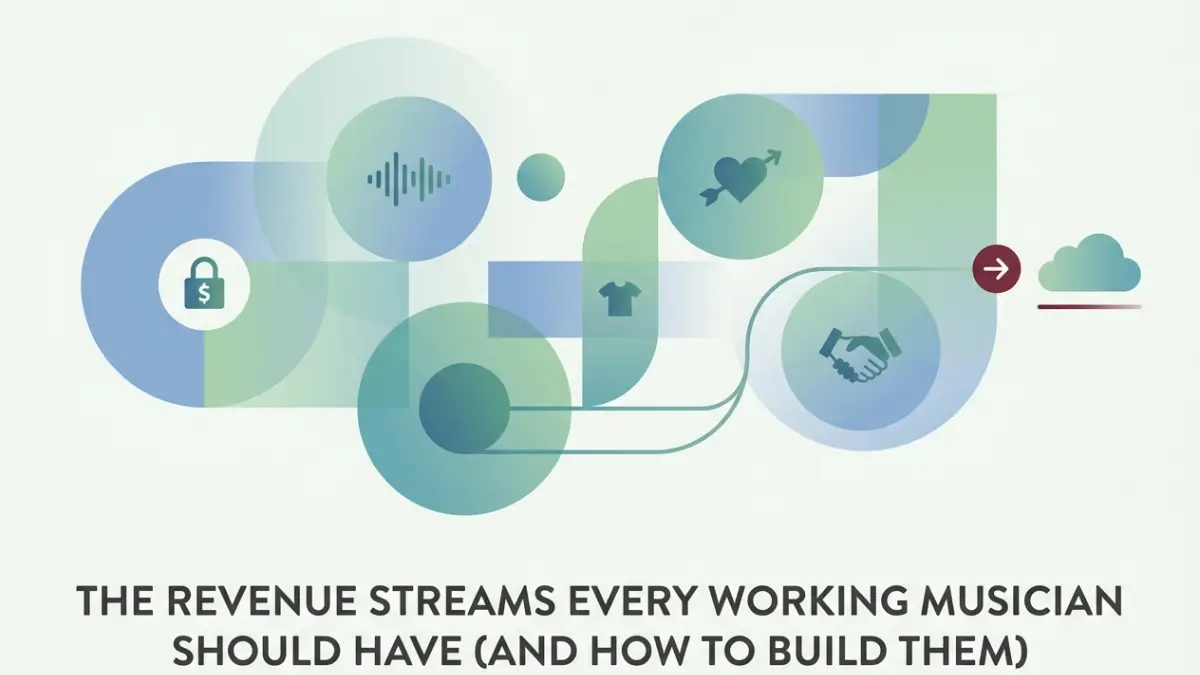
That architecture breaks down into six core revenue categories: streaming and recorded music royalties, sync licensing, live performance, merchandise and physical media, direct fan support, and brand partnerships. Each one operates differently, pays on a different timeline, and requires a different set of conditions to activate.

The critical variable most artists ignore is sequencing. These streams are not equally accessible at every career stage, and treating them as interchangeable wastes two resources that early-career musicians have least of: time and money. Streaming and merch can run from day one with minimal overhead. Sync licensing and brand partnerships require catalog depth, clean rights documentation, professional-quality recordings, and demonstrable audience traction before they become viable, not theoretical.
The revenue data makes the sequencing argument harder to ignore. According to RIAA mid-year figures, the two fastest-growing music industry revenue categories in H1 2026 are sync licensing (up 18.2% to $231.8M) and physical media (up 25.9%, with vinyl at $544M and CDs up 58.6%). These are precisely the categories most independent artists underinvest in, partly because they require more setup than uploading to a distributor, and partly because their growth rarely gets the same visibility as streaming headlines.
Building multiple stacked music revenue streams also changes the risk profile of a music career. When one stream underperforms, the others hold. That structural stability is what separates a working musician from an artist entirely dependent on platform decisions they cannot control. Understanding how to connect each revenue layer to the next is what a structured revenue system is actually designed to do.
The sections below cover each stream in activation order, starting with what artists can turn on immediately and moving toward streams that reward a more established foundation.
Stream 1: Streaming and Recorded Music Royalties
Streaming is the first stream to activate, and the activation cost is effectively zero.
Every artist with recorded music should be distributing to Spotify, Apple Music, Amazon Music, YouTube Music, and TIDAL. Distributors like DistroKid, TuneCore, and CD Baby handle delivery to all major platforms for a flat annual fee or per-release cost. Platform presence compounds: catalog uploaded today earns indefinitely without additional effort.
Collect both sides of your royalties. Streaming generates two separate income streams: master royalties (paid to whoever owns the recording) and publishing royalties (paid to the songwriter). A distributor handles the master side. Publishing royalties require a separate registration with a publishing administrator, such as Songtrust or DistroKid's publishing add-on. Artists who write their own songs and skip this step are leaving money uncollected on every stream.
Prioritize paid-tier platforms. According to RIAA mid-year data, paid subscriptions grew 6.4% in H1 2026 and now account for 111.1 million accounts, while ad-supported free streaming grew only 3.7%. Paid-tier listeners generate meaningfully higher per-stream payouts. Apple Music and TIDAL operate with predominantly paid subscriber bases, which is why catalog placement there matters despite lower overall listener counts compared to free-tier-heavy platforms.
Use playlist pitching for audience growth, not income forecasting. Submit new releases through Spotify for Artists at least seven days before the release date to be eligible for editorial consideration. Third-party pitching services can supplement this, but playlist placement does not reliably translate into significant income at the independent artist level. Treat any stream lift as audience expansion, not revenue planning.
Extract the strategic intelligence streaming provides. Spotify for Artists and Apple Music for Artists show which cities stream your music most, listener age and gender breakdowns, and which tracks retain attention. This data directly informs live show routing and merch decisions. For working musicians building multiple revenue streams, that intelligence may ultimately be worth more than the royalty check itself.
For straight answers for artists and music businesses on building the full revenue picture, streaming is where the foundation starts.
Stream 2: Sync Licensing
Streaming builds your audience. Sync licensing pays your rent.
Sync licensing reached $231.8M in H1 2026, up 18.2% year-over-year, making it one of the fastest-growing major revenue categories in the US recorded music market. Most independent artists are not pursuing it. That is a significant gap worth closing.
How sync licensing works: A sync license grants a music supervisor, brand, filmmaker, or game developer the right to place your song against video content. The deal pays two ways: a sync fee upfront (a one-time placement fee negotiated before the content is published) plus ongoing performance royalties each time that content airs or streams. One placement can generate income for years.
What sync-ready actually means: Before submitting anywhere, confirm you have three things in order:
Clean splits documentation confirming who controls the master recording and who controls the publishing rights, in writing
High-quality stems and instrumental versions of your tracks, mix-ready and exported at professional specs
Metadata embedded in every audio file, including song title, artist name, ISRC, and rights contact information
Missing any of these stops a placement before it starts. Music supervisors will not chase down rights information.
Where to get placed: Non-exclusive sync libraries are the most practical entry point for independent artists. Search for platforms that accept open submissions and pay per placement. For direct supervisor access, structured pitching communities and licensing conferences provide pathways to active licensors.
What gets selected: Supervisors favor tracks with clean, instrumentally diverse arrangements. Lyrics that are universal or absent entirely work best for background applications. Build a catalog of tracks mapped to common placement categories: corporate, documentary, fitness, automotive, and travel content all license at high volume.
Brand sync deals: Fees vary widely by brand size, usage rights, and territory; even regional placements can represent meaningful income compared to streaming equivalents. Artists with even modest but genuinely engaged audiences are competitive here, particularly with brands in fitness, beverage, and lifestyle categories where cultural alignment matters more than raw follower count.
Stream 3: Live Performance
Unlike sync licensing, where placement depends on a music supervisor's decision, live performance puts the artist fully in control. You set the price, the frequency, and the scale. No algorithm determines whether the show happens or what it pays.
Revenue at a single show is multi-layered. A performance can generate a flat guarantee or a door deal (a percentage of ticket sales), merch revenue from a table at the venue, and tips or direct Venmo payments at smaller club and bar gigs. Treating each show as a bundled revenue event rather than a single-fee transaction meaningfully increases income per performance without adding a second booking.
Sequencing matters early in a career. Start in local and regional markets where travel overhead is low and you can build a consistent draw. The streaming analytics introduced in Stream 1 identify cities where fans already exist before you route further out; booking into that existing demand is a fundamentally different risk profile than blind touring. Understanding the five stages revenue actually moves through helps clarify why audience-first routing is a financial decision, not just a logistical one.
The most overlooked live revenue category is private events. House concerts, corporate gigs, and wedding circuits pay flat fees that frequently exceed club door deals, with none of the draw pressure a traditional venue booking carries. Artists locked into the standard venue circuit often leave this income entirely uncaptured.
Performance royalties attach to every live show where you play original songs. Venues with blanket licenses from ASCAP or SESAC (or BMI) pay into PRO royalty pools. To collect your share, you must be registered with a PRO and submit setlists after each performance. This is separate income from the performance fee itself, and most artists who are not yet registered are leaving it on the table at every show.
Stream 4: Merchandise and Physical Media
Live shows are already your highest-converting selling environment, and merchandise turns that conversion into a revenue stream that travels beyond the venue.
Physical media is not a nostalgia play. As noted earlier, vinyl and CD revenues surged in H1 2026, marking the 19th consecutive year of vinyl growth. Collectors and engaged fans want tangible connections to artists they care about, and the market data confirms that demand is accelerating, not fading.
The margin case for direct-to-fan sales is straightforward. Selling a $30 vinyl at a show or through a Bandcamp page puts the majority of that sale directly in your pocket. Streaming the same album returns fractions of a cent per play. Same music, radically different economics. Direct channels are where physical and merch revenue compounds meaningfully.
For artists not ready to commit to bulk inventory, print-on-demand is a practical entry point. Platforms like Printful and Printify integrate with Shopify or Bandcamp stores, letting you offer apparel, posters, and accessories with zero upfront cost. The tradeoff is real: print-on-demand margins run significantly lower than bulk-manufactured merch. The right model depends on your current volume. Start with print-on-demand, and reinvest profits into bulk orders once demand justifies it. This same logic applies to understanding the formats driving affiliate revenue growth in 2026, where low-barrier entry points often precede higher-margin structures.
Limited and exclusive products unlock collector pricing. Colored vinyl variants, signed copies, and deluxe bundles command premiums well above standard retail. Artists with even modest followings can sell out runs of 100 to 500 units at multiples of base cost. Scarcity is a real signal to buyers when the product is genuinely limited.
At shows, the merch table outperforms your online store every time. Clear pricing, a card reader, and a QR code linking to your online store are the minimum setup. The emotional context of a live performance is the highest-converting environment a musician has access to. Post-show online sales rarely match what moves in the room.
Stream 5: Direct Fan Support and Membership
Merch converts fans who are already paying attention. Direct fan support converts that attention into recurring, predictable income without requiring a new sale each month.
Platforms like Patreon, Bandcamp subscriptions, and Substack let artists monetize a committed core audience directly. The math is straightforward: 200 supporters at $5 per month generates $1,000 in recurring monthly income. Reaching that threshold requires far fewer fans than generating equivalent income from streaming, where $1,000 demands millions of plays. Patreon has paid creators over $10 billion cumulatively since 2013 and distributes more than $2 billion annually, confirming the model works at scale.
The activation threshold is engagement, not audience size. Artists with a small but genuinely engaged audience can launch a viable membership tier, size matters less than commitment and consistent output. The deliverables that sustain subscriptions are exclusive tracks, early access to releases, behind-the-scenes content, and direct Q&A access. None of these require expensive production, but all require consistency.
Bandcamp remains one of the most artist-favorable direct sales platforms available. Bandcamp is designed to favor artist economics over platform take rates, consult Bandcamp's current fee schedule for exact split details.
YouTube represents a parallel channel worth stacking alongside a Patreon or Bandcamp membership. AdSense revenue, channel memberships, and Super Chat payments during live streams are three distinct income lines available to artists who post video content consistently. Live sessions, lyric videos, and studio footage all qualify. The same community-first approach that powers Patreon also underlies effective YouTube growth; this overlap is explored in depth in Strategy 5: Creator and Community Marketing Outperforms Polished Ads.
Before launching any membership tier, audit your current content output honestly. An inactive or lapsed membership page signals unreliability and accelerates subscriber churn. Commitment to the model is the variable that separates artists who build durable recurring income from those who launch and stall.
Stream 6: Brand Partnerships and Sponsorships
Direct fan support builds recurring income from your most committed listeners. Brand partnerships operate at a different ceiling entirely.
Of all the music artist revenue streams available without major label infrastructure, brand deals offer the highest single-activation upside. A mid-size independent artist with a loyal niche audience can close a single partnership that exceeds months of accumulated streaming royalties. The math is not close.
What brands are actually buying
Brands pursuing music partnerships are not buying follower counts. They are buying audience access, content authenticity, and cultural credibility. An artist with 8,000 highly engaged followers in a specific demographic routinely outcompetes a larger account with passive reach. Engagement rate, audience demographics, and the alignment between the artist's image and the brand's positioning are the deciding factors in whether a deal gets offered and at what rate.
Common partnership structures
Four structures dominate the market:
Sponsored social content: the brand pays for posts, stories, or short-form video featuring their product
Brand-funded music videos or content series: the brand underwrites production in exchange for placement and co-branding rights
Tour or event sponsorship: the brand funds or co-presents live shows, often with signage, sampling, or ticketing integration
Direct sync negotiation: the brand's marketing team licenses a track directly, bypassing traditional sync libraries and often moving faster with more favorable terms
Industries actively spending on artist partnerships
Alcohol and beverage brands have the longest track record in music sponsorship. Fitness and athleisure, footwear, automotive, and gaming categories follow with consistent activity. Cannabis and hemp brands represent a significant and growing opportunity, particularly in markets where paid digital advertising restrictions push those budgets toward influencer and artist partnerships as a primary channel.
The entry point: your media kit
Before any serious brand conversation starts, an artist needs a media kit. One page covering audience demographics, platform engagement rates, streaming numbers, any prior brand work or press, and a clear articulation of what the artist's audience represents culturally. That document is the difference between getting a response and getting ignored.
ELM Tree Marketing works with both music artists and 21+ brands, including beverage and hemp, to structure these partnerships and build the content strategies that make them perform. For artists who want to understand what the right agency relationship looks like for this strategy, the foundation starts with having the right infrastructure before the first pitch goes out.
How to Sequence These Revenue Streams by Career Stage
Knowing which streams exist matters less than knowing when to activate each one. Here is how to build in sequence.
Stage 1: Under 1,000 Monthly Listeners
Start with zero-cost infrastructure. Get your music on all major platforms through a distributor and register with a PRO (ASCAP, BMI, or SESAC) immediately; both moves cost little or nothing and begin accumulating royalty rights from day one. Start performing locally, even small rooms, to build a live draw. Launch a Bandcamp page with name-your-price or low-cost digital downloads. That first fan transaction, however small, establishes a direct commercial relationship no platform can revoke.
Stage 2: 1,000 to 10,000 Monthly Listeners
Add merch using print-on-demand to avoid inventory costs. Submit your catalog to sync libraries that accept open submissions; you do not need major placements yet, you need your music in systems where it can be discovered. Most importantly, start capturing email addresses at every touchpoint: shows, link-in-bio, Bandcamp checkout. Your email list is the only audience asset you fully own, unlike streaming followers or social media subscribers, it lives on infrastructure you control regardless of platform policy changes.
Stage 3: 10,000+ Monthly Listeners With Real Engagement
Now pursue relationship-dependent streams. Launch a Patreon or Bandcamp subscription for recurring revenue. Invest in a limited vinyl or CD run; as the H1 2026 figures covered earlier show, physical demand is real and growing. Begin direct outreach to sync supervisors and approach brand partnerships with a media kit ready.
The Through-Line at Every Stage
Treat streaming data as strategic intelligence. Your top cities inform tour routing. Your demographic data shapes merch and brand pitches. Your best-performing tracks tell you what to record next.
The sequencing principle is straightforward: build the system before the campaign. Stack low-cost always-on streams first, add performance-based streams second, pursue relationship-dependent streams once you have something concrete to bring to the table.
What Most Musicians Miss About Music Industry Revenue
Sequencing your streams is the structural move. Understanding where money disappears before it reaches you is the one that keeps the architecture intact.
Publishing royalties are split into three separate income lines, each requiring its own registration. PRO performance royalties (collected by ASCAP, BMI, or SESAC) require PRO membership. Mechanical royalties from streaming require a publishing administrator. Sync publishing fees require both clear rights documentation and an active publishing entity. Independent artists who skip any of these registrations leave real money uncollected, not because the revenue doesn't exist, but because no one claims it on their behalf.
RIAA revenue figures reflect wholesale numbers, not artist net income, as established earlier, the $6 billion reported for H1 2026 flows to rights holders before independent artists see a fraction of it, and closing that gap requires registration, documentation, and consistent administration rather than a label deal.
Per-stream payouts are not uniform. Premium-tier streams generate meaningfully higher per-stream payouts than ad-supported streams, the gap is well-documented directionally, though exact multiples vary by platform and territory. Streams from higher-income markets (the US, UK, Germany, Australia) pay meaningfully more than streams from lower-income geographies. Prioritizing platforms with premium-heavy listener bases produces higher royalties from the same play count.
The fastest-growing revenue categories are the ones most independent artists ignore. Sync licensing and physical media both posted double-digit growth in H1 2026, while streaming grew 4.7%. Realigning even a portion of effort toward sync submissions and physical product often produces better returns than optimizing streaming numbers.
Treat the music career as a business with an actual income statement. Track revenue by source. Identify which streams carry fixed costs and which scale with audience. Reinvest income from stable streams to activate the next tier. That operational discipline is what separates artists who build long-term sustainability from those who plateau when one stream underperforms.

Building a Revenue Architecture That Lasts
Managing income by source is the operational foundation. Building the architecture that generates it is the strategic one.
Streaming is a discovery layer. It surfaces your music to new listeners, feeds algorithm-driven recommendations, and builds geographic audience data you can act on. It is not a business model. A sustainable music career runs on stacked, sequenced revenue: streaming, sync, live performance, merch, direct fan support, and brand partnerships working together, each one funding activation of the next.
The four foundational moves cost almost nothing and unlock everything else, register with a PRO, set up a distributor, launch a Bandcamp page, and start building an email list, as laid out in the sequencing section above. Skip them and you are building on someone else's platform indefinitely.
Sync and physical media are the two highest-growth categories most independent artists are not pursuing. Any artist with a clean catalog, documented rights splits, and mix-ready stems should be submitting to sync libraries now. The market is growing and the competition from independent artists remains thin.
Brand partnerships have the highest revenue ceiling outside of label infrastructure, but they require infrastructure to access. A real website, documented audience analytics, and a media kit are the minimum entry point for serious brand conversations. This is where a performance marketing partner like ELM Tree Marketing helps artists build the foundation that makes those conversations convert, not just happen.
The goal is not to activate every stream simultaneously. It is to sequence them so each one funds the next, compounding stability over time.
Conclusion
A sustainable music career is not built on a single revenue source. It is built on a deliberate architecture of streams, each one reinforcing the next. Register your rights, own your audience, pursue sync opportunities your competitors are ignoring, and sequence each new stream as your foundation grows stronger.
The artists who last are not the ones who got lucky with a viral moment. They are the ones who treated their music like a business, built real infrastructure, and diversified before they needed to.
You do not have to build everything at once. Start with the four foundational steps, add one stream at a time, and let momentum compound.
If you are ready to build the marketing foundation that makes every revenue stream perform better, ELM Tree Marketing is here to help you get there.
FAQ
How much money do musicians actually make per stream on platforms like Spotify?
Spotify and other streaming platforms pay fractions of a cent per stream. The exact amount varies based on several factors: whether the listener has a paid subscription or uses ad-supported free tier (paid tiers generate meaningfully higher per-stream payouts), the listener's geographic location (streams from higher-income markets like the US, UK, Germany, and Australia pay significantly more than streams from lower-income geographies), and the specific platform algorithm. Additionally, independent artists must account for distributor fees, co-writer/producer cuts, and platform royalty calculations before receiving their portion, making streaming an unreliable primary income source.
What is sync licensing and why is it growing so much faster than streaming?
Sync licensing grants music supervisors, brands, filmmakers, or game developers the right to place your song against video content. It pays two ways: an upfront sync fee (a one-time placement fee negotiated before publication) plus ongoing performance royalties each time the content airs or streams. Sync licensing grew 18.2% in H1 2026, making it one of the fastest-growing revenue categories. It's growing faster than streaming because it directly monetizes the value of your music in premium contexts, with single placements potentially generating income for years, while streaming's growth is only 4.7% despite the larger dollar volume.
At what stage of my music career should I pursue each revenue stream?
Revenue streams should be sequenced based on career stage: Under 1,000 monthly listeners—focus on zero-cost infrastructure (distributor, PRO registration, Bandcamp, local performances). From 1,000-10,000 monthly listeners—add print-on-demand merch, submit to sync libraries, and build your email list. At 10,000+ monthly listeners with real engagement—pursue Patreon/Bandcamp subscriptions, invest in physical media runs, and begin direct sync supervisor and brand partnership outreach. This sequencing matters because early streams require minimal overhead while later streams depend on having an established foundation and documented audience to attract.
What documentation and preparation do I need before submitting music for sync licensing?
Before submitting anywhere for sync licensing, you must have three things in order: (1) Clean splits documentation confirming in writing who controls the master recording and who controls the publishing rights, (2) High-quality stems and instrumental versions of your tracks, mix-ready and exported at professional specs, and (3) Metadata embedded in every audio file, including song title, artist name, ISRC, and rights contact information. Missing any of these stops a placement before it starts, as music supervisors won't chase down rights information. This preparation is what separates ready-to-license artists from those who lose opportunities.
How can I make meaningful money from brand partnerships as an independent artist?
Brand partnerships often provide the highest revenue ceiling for independent artists outside of major label infrastructure—a single mid-size deal can exceed months of accumulated streaming royalties. Brands are buying audience access, content authenticity, and cultural credibility, not follower counts. An artist with 8,000 highly engaged followers often outcompetes larger but passive accounts. To access these partnerships, you need: a professional media kit (one page covering audience demographics, platform engagement rates, streaming numbers, prior brand work, and cultural positioning), documented audience analytics, and a clear understanding of which industries are actively spending (alcohol/beverage, fitness/athleisure, footwear, automotive, gaming, and cannabis/hemp). Common partnership structures include sponsored social content, brand-funded music videos, tour sponsorships, and direct sync negotiations.